Recipe & Meal Cost Calculator Nigeria (Free) - Jollof, Egusi, Beans & More
Work out exactly how much a Nigerian meal costs to cook per pot and per person, then compare it to eating out.
Ingredients
Local measures like "derica" and "bunch" are approximate — a derica of rice is roughly 2.5–3kg, but exact weight varies by vendor and by grain.
Total for 5 servings
₦10,800
₦2,160 per person
| Ingredient | Qty | Unit price | Cost |
|---|---|---|---|
| Rice | 2 derica | ₦1,800 | ₦3,600 |
| Tomatoes | 1 kg | ₦900 | ₦900 |
| Pepper mix (tatashe/rodo) | 1 kg | ₦1,200 | ₦1,200 |
| Onions | 3 piece | ₦150 | ₦450 |
| Vegetable oil | 0.5 l | ₦1,400 | ₦700 |
| Chicken | 1 kg | ₦3,500 | ₦3,500 |
| Seasoning cubes | 6 piece | ₦25 | ₦150 |
Prices shown for preset recipes are illustrative starting points based on common Nigerian market ranges, not live data — this tool does not sell food, set prices, or connect to any market feed. Always confirm current prices locally before budgeting. Nutrition note: these meals are carbohydrate-heavy; balance with vegetables and protein where your budget allows. Check NAFDAC guidance for food safety — this tool covers cost only, not health advice.
How Much Does It Really Cost to Cook a Nigerian Meal? A Practical Meal Cost Calculator
Last updated: August 2026·Reviewed by Chidinma Okafor, Tax Analyst in Lagos·Source
A pot of jollof rice or egusi soup costs more than the headline ingredients suggest once cooking fuel, oil, and seasoning are properly counted — which is exactly where informal estimates go wrong.
What's easy to leave out of a mental estimate
| Often forgotten | Why it matters |
|---|---|
| Cooking gas/electricity | Real cost for an hour+ of cooking |
| Oil quantity | Frequently the second-largest line item after protein |
| Seasoning/stock cubes | Small individually, adds up across a full pot |
Worked example
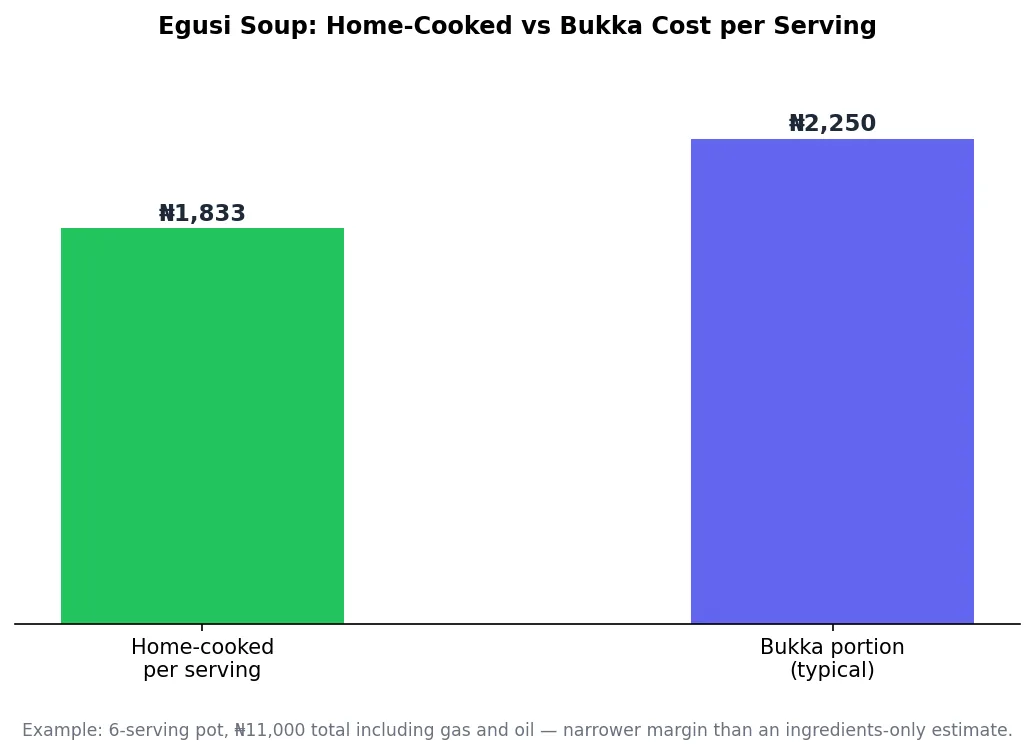
A pot of Egusi soup for 6 servings: melon seeds ₦3,500, palm oil ₦1,200, protein ₦4,000, vegetables and seasoning ₦1,800, cooking gas estimate ₦500.
- Total pot cost: ₦3,500 + 1,200 + 4,000 + 1,800 + 500 = ₦11,000
- Per serving: ₦11,000 ÷ 6 = ₦1,833
Compared against a similar-sized bukka portion at ₦2,000–2,500, home cooking still comes out ahead here — but the margin is narrower than a rough ingredients-only estimate would suggest.
Things to know
- A derica, the small tin used for measuring rice and beans in local markets, is treated as roughly 2.5–3kg here — since it isn't a fixed legal measure, adjust the unit price to match what you actually paid.
- The NBS-published cost of a healthy diet (roughly ₦1,400–1,700 per adult per day in recent reporting) is a useful anchor for comparison, not a live or continuously updated figure.
- Prices are user-entered estimates, not a live market feed — replace the defaults with your own recent market prices for an accurate result.
Anyone who shops regularly in a Nigerian market knows that the price on a receipt rarely matches what was budgeted the week before. Rice, tomatoes, pepper and cooking gas move week to week, and a household that does not track these changes can end up overspending on meals without ever noticing where the money went. A meal cost calculator built specifically for Nigerian food gives households, students and small food vendors a fast way to see, ingredient by ingredient, exactly what a pot of food costs and what that works out to per plate.
The idea behind this recipe and meal cost calculator is simple. Instead of guessing a total at the till, you list out what actually goes into a meal, such as Jollof rice, Egusi soup and swallow, Beans porridge, Fried rice, Indomie and egg, Amala and Ewedu, White rice and stew, or Garri and soup, with the quantity of each ingredient, the unit it is measured in, and the price you paid or expect to pay. Nigerian cooking uses local measures that a generic international calculator does not understand, so this tool builds in kilograms, grams, litres, millilitres, pieces, bunches, cups and the derica, the small measuring tin widely used for rice and beans in local markets. A derica of rice is commonly treated as roughly two and a half to three kilograms, but because the tin itself is not a fixed legal standard of measurement, the calculator treats that conversion as an estimate and encourages every user to adjust the unit price to match what they actually paid, rather than relying on a fixed formula.
Once the ingredients are listed, the calculator adds a fuel, gas or electricity estimate, since cooking a heavy soup on a gas cylinder or over a stove for an hour is a real cost that a simple ingredient list leaves out. It then divides the full total by the number of servings the recipe is meant to feed, giving a clear per-person cost. This single number is often the most useful output, because it lets a household compare cooking a large pot of Egusi soup at home against buying the equivalent from a bukka or roadside food seller, and it lets a student or single professional judge whether a smaller custom recipe is genuinely cheaper than ordering food.
The calculator also surfaces which ingredients are driving the bill. For a typical Jollof rice recipe, rice and cooking oil frequently account for a large share of the total cost, while for Egusi soup, the melon seeds, palm oil and protein usually dominate. Seeing this breakdown, rather than only a final number, helps a household decide where a substitution, such as swapping a portion of meat for stockfish, or adjusting the oil quantity, would meaningfully reduce cost without changing the meal.
For context, the National Bureau of Statistics, the federal agency responsible for producing Nigeria's official price and cost-of-living statistics, has published estimates of the cost of a healthy diet per adult per day. This calculator references that kind of benchmark, currently in the range of roughly one thousand four hundred to one thousand seven hundred naira per adult per day depending on the reporting period, purely as a point of comparison, not as a live or continuously updated feed. Because official statistics are published periodically rather than in real time, and because market prices vary heavily by state, season and vendor, the benchmark inside the tool is clearly dated and should be treated as a rough anchor rather than an exact current figure.
On the consumer protection side, the Federal Competition and Consumer Protection Commission, established under the Federal Competition and Consumer Protection Act 2018, is the body responsible for consumer protection and fair trading standards in Nigeria, including transparency in how prices and estimates are presented to the public. This tool does not set, regulate or guarantee any price; it simply helps a user organise their own numbers. In line with that Act's transparency expectations, every result carries a clear disclaimer that figures are user-entered estimates rather than live market data, and that the tool does not sell food, does not process payments and does not claim any medical or nutritional authority. Users who want confirmation of food safety standards for ingredients like meat, fish or packaged seasoning are pointed toward the National Agency for Food and Drug Administration and Control, NAFDAC, whose remit covers food safety rather than pricing.
In practice, the most common use of this tool is quick and repeatable: pick a preset recipe close to what is being cooked, correct two or three prices to match the day's market visit, adjust servings to match the household size, and read off the per-person cost. Over a few weeks of doing this consistently, a household builds a much clearer picture of which meals are genuinely economical and which ones only feel cheap until the full ingredient list, including oil, seasoning and cooking fuel, is added up properly. That habit, more than any single calculation, is what turns a simple calculator into a real food budgeting tool for the Nigerian context.