Generator Fuel Cost vs Solar Payback Calculator Nigeria (2026)
Compare your generator's monthly fuel and maintenance cost against a solar system's payback period, in naira.
Quick presets
Your generator
Default reflects pump prices around ₦1,250–₦1,200/L as of 2026-07-01. Edit to match your local price.
Solar assumptions
Lithium battery packs typically need replacing every 8–12 years; the projection below assumes one replacement around year 10 if your projection window is long enough.
Results
Generator cost / month
₦484,500
Generator cost / year
₦5,814,000
Estimated savings / month
₦339,150
Estimated savings / year
₦4,069,800
Payback period
1 yr 0 mo
Range at ±20% fuel price: 10 months best case, 1 yr 3 mo worst case.
Cumulative cost over 10 years
Estimates only. Actuals vary with usage, maintenance, fuel prices, system quality, and installation. Not financial advice.
Generator Fuel Cost vs Solar Payback Calculator: What It Really Costs to Power Your Home in Nigeria
Last updated: August 2026·Reviewed by Chidinma Okafor, Tax Analyst in Lagos·Source
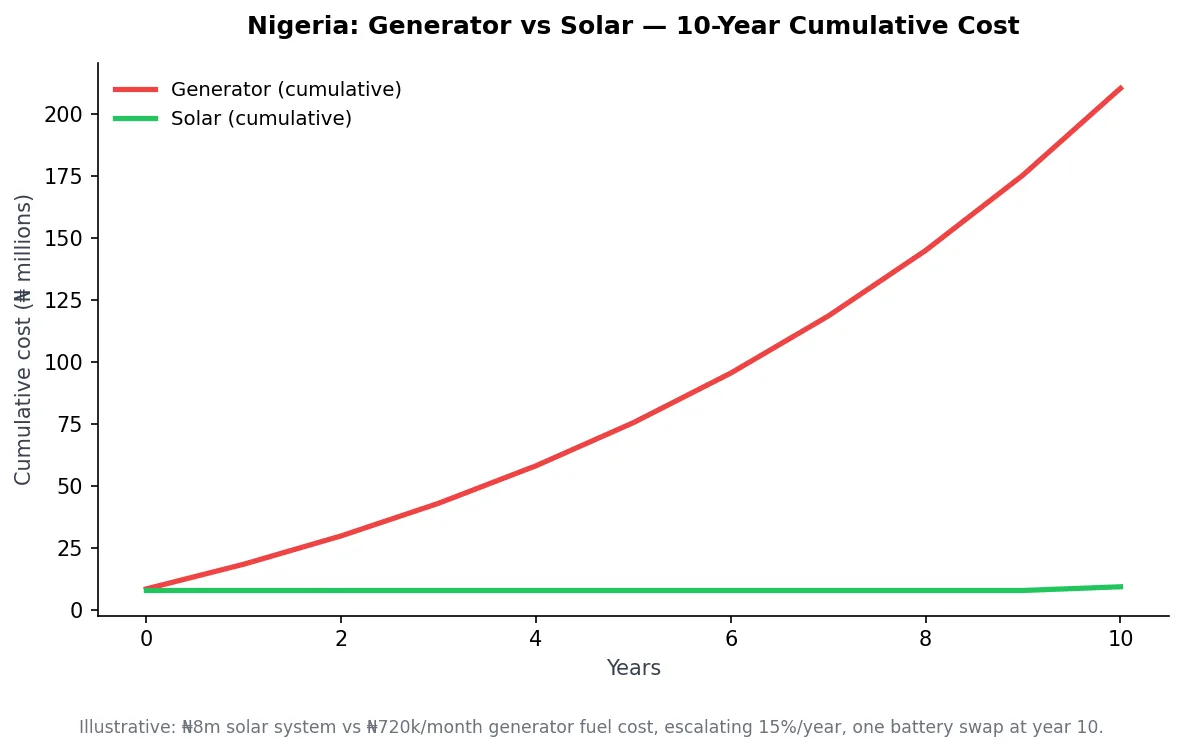
A generator's cost is spread across fuel and maintenance every single month for as long as you run it. Solar's cost is almost entirely upfront — which means the comparison is really about how fast solar's one-time cost catches up to the generator's ongoing bleed.
How it's calculated
Monthly generator cost = (litres/hour × runtime hours/day × 30) × fuel price, plus periodic maintenance. Payback period = solar system cost ÷ monthly generator cost saved, adjusted for fuel price escalation over time.
| Generator (5kVA, 8hrs/day) | Solar (equivalent capacity) | |
|---|---|---|
| Upfront cost | Low (just the unit) | High (panels, inverter, battery) |
| Ongoing cost | Fuel + maintenance, every month | Near-zero, until battery replacement |
| Typical payback vs generator | — | 16–36 months (heavy use) |
Worked example
A 5kVA petrol generator run 8 hours/day, fuel at ₦1,200/litre, consuming ~2.5 litres/hour.
- Monthly fuel cost: 2.5 × 8 × 30 × ₦1,200 = ₦720,000/month
- Add maintenance: monthly cost lands ₦250,000–₦400,000+/month depending on load and price
- A solar system costing ₦8,000,000 upfront would pay back against this generator cost in roughly 20–32 months, before accounting for rising fuel prices, which shortens payback further
Things to know
- Fuel price escalation compounds the generator's cost curve upward over time, while solar's cost stays mostly flat — the comparison favors solar more the longer the horizon.
- Lithium battery packs in Nigerian solar hybrid systems typically need replacement every 8–12 years — a full payback comparison should include one partial replacement cost around year 10.
- Actual payback depends heavily on your specific runtime hours and local fuel price — a lightly-used generator will show a much longer payback period than a heavily-used one.
Nigerian households and small businesses have lived with the hidden cost of self-generated power for decades, and since the removal of the petrol subsidy in May 2023 that cost has become impossible to ignore. A typical 5kVA petrol generator running eight hours a day at a Lagos pump price of roughly one thousand two hundred naira per litre can burn through well over three hundred thousand naira a month once fuel and servicing are added together. This generator fuel cost calculator and solar payback calculator was built to turn that vague sense of "generators are expensive" into an actual number, and then to compare it against the upfront cost of a solar and lithium battery hybrid system, so a Lagos, Abuja, or Port Harcourt household can see exactly how many months or years it would take to break even.
The calculator works from figures you control. You choose whether your generator runs on petrol (PMS, Premium Motor Spirit) or diesel (AGO, Automotive Gas Oil), select a generator size from 2.5kVA up to 10kVA, and set your average daily runtime and typical load. Nigeria's Dangote Petroleum Refinery has been supplying an increasing share of domestic PMS and AGO since it began full operations, and its ex-depot gate price is one of the reference points that pump prices across the country track, alongside NNPCL (Nigerian National Petroleum Company Limited) stations and independent marketers under IPMAN, the Independent Petroleum Marketers Association of Nigeria. Because there is no free, keyless, live-updating public feed for Nigerian pump prices as of today, this tool ships with editable default prices rather than a fake live ticker, and shows the date those defaults were last checked so you always know you're looking at a real, current figure and not a stale automated pull.
Fuel consumption is estimated using published genset specification ranges and Nigerian market averages for each size class, then adjusted for how hard you're running the machine. A generator does not sip fuel proportionally down to zero at low load; even idling, it burns a meaningful base amount, so the calculator applies a partial-load correction rather than a straight-line scale. Maintenance, covering routine oil changes, air and fuel filters, and periodic servicing, is added on top as a separate monthly line so the total cost of ownership reflects what generator owners actually pay, not just the pump receipt.
On the solar side, the calculator uses realistic hybrid system cost ranges for lithium battery setups sized to replace a given generator's typical output, based on current Nigerian solar installer pricing patterns. You can override the system cost with your own installer quote, set what percentage of your generator's runtime the solar system is expected to replace (a full off-grid switch is rarely realistic for larger loads, so a partial offset is the default assumption), and adjust panel lifespan and expected annual fuel price escalation. The payback period is calculated by dividing the solar system's upfront cost by the annual savings it generates, and the tool also shows a best-case and worst-case range by flexing the fuel price twenty percent in either direction, since Nigeria's naira-denominated fuel prices have moved sharply within single calendar years. A ten-year cumulative cost chart lets you see the full picture: generator running costs rising every year as fuel prices climb, against a solar path where the big cost is paid upfront and a partial battery replacement is factored in around year ten, reflecting the eight-to-twelve-year lifespan typical of lithium battery packs.
None of this is guesswork dressed up as certainty. Every default in the calculator is labelled as an estimate, every formula is visible in how the results change as you adjust the sliders, and the results panel repeats, in plain language, that actual outcomes depend on your specific equipment, installation quality, maintenance discipline, and how fuel and solar equipment prices move over the years you own the system. The tool makes no guaranteed-savings claim, in line with general consumer protection expectations under the Federal Competition and Protection Commission (FCCPC), which polices misleading commercial claims in Nigeria. It also collects no personal data: every input stays in your browser, nothing is submitted to a server, and no account or persistent profile is created, so there is nothing here that touches the obligations set out in the Nigeria Data Protection Act (NDPA).
Why does this matter beyond curiosity? Nigeria's electricity supply from the national grid, regulated by NERC and distributed through the DISCOs, remains unreliable enough in most cities that generators are not a backup but a primary power source for millions of households and small businesses. That makes the generator running cost one of the largest, least-visible line items in a Nigerian household budget, often exceeding rent-adjacent utility costs but rarely tracked with the same discipline as a fuel or data subscription. At the same time, solar and lithium battery hybrid systems have become dramatically more affordable and more common over the last few years, to the point where payback periods that once stretched past a decade can now land inside two to three years for households with heavy, consistent generator use. This calculator exists to make that comparison concrete for your specific situation rather than relying on generic marketing numbers from a solar installer with an obvious incentive to make the payback look faster than it is. Adjust the assumptions honestly, compare the range rather than a single headline number, and use the result as a starting point for getting real quotes, not as a final financial decision.