Grocery & Meal Cost Estimator Nigeria (Free Naira Calculator)
Estimate the cost of groceries or specific Nigerian meals in Naira using sample NBS and market-survey prices, adjustable by location and household size.
Estimate the cost of groceries or specific meals using sample Nigerian market prices. Use it for budgeting, meal planning, or comparing options — then verify prices at your local market.
Local Rice
₦1,600 / kg
Foreign Rice
₦2,100 / kg
Garri (White)
₦800 / kg
Garri (Yellow, Ijebu)
₦950 / kg
Brown Beans (Oloyin)
₦1,900 / kg
White Beans
₦1,500 / kg
Spaghetti
₦950 / 500g pack
Indomie Noodles
₦1,400 / pack of 5
Semovita
₦3,200 / 2kg pack
Yam
₦2,200 / medium tuber
Plantain (Unripe)
₦2,000 / bunch
Sweet Potato
₦700 / kg
Irish Potato
₦1,100 / kg
Chicken (Live/Dressed)
₦4,200 / kg
Beef (Boneless)
₦7,200 / kg
Titus Fish (Frozen)
₦3,600 / kg
Dried/Smoked Fish
₦6,500 / kg
Eggs
₦4,200 / crate of 30
Turkey (Parts)
₦6,000 / kg
Fresh Tomato
₦1,500 / kg
Pepper Mix (Tatashe/Rodo)
₦1,800 / kg
Onion
₦1,200 / kg
Ugu (Fluted Pumpkin Leaf)
₦700 / bunch
Spinach (Green)
₦500 / bunch
Okra
₦1,300 / kg
Palm Oil
₦2,400 / 1L bottle
Vegetable Oil
₦2,600 / 1L bottle
Groundnut Oil
₦3,200 / 1L bottle
Egusi (Melon Seed)
₦3,800 / kg
Crayfish (Ground)
₦8,500 / kg
Salt
₦350 / 500g pack
Seasoning Cubes
₦1,600 / pack of 50
Sugar
₦1,300 / kg
Bread (Sliced Loaf)
₦1,500 / loaf
Milk (Powdered)
₦3,400 / 400g tin
Your List
No items yet. Add items or pick a meal.
Estimated total
₦0
≈ ₦0 per person (4 people)
Prices shown are sample averages sourced from NBS Selected Food Price Watch data and public market surveys as of June 2026; they are approximations, not live quotes, and can differ substantially by vendor, season, and exact location (for example, Lagos vs. Kano). The optional USD figure uses a floating reference exchange rate for convenience only and is not a transactional rate. Always confirm current prices with a local vendor or market before budgeting large purchases. Locale: en.
Grocery & Meal Cost Estimator for Nigeria
Last updated: August 2026·Reviewed by Chidinma Okafor, Tax Analyst in Lagos·Source
Nigerian food prices swing sharply by state and season, which is exactly why a single national grocery figure is close to useless for real budgeting.
What drives the estimate
| Factor | Effect |
|---|---|
| Location (Lagos, Abuja, Kano, PH, national avg.) | Regional price multiplier |
| Household size | Per-person cost |
| Market variability buffer | Optional cushion for price swings |
Worked example
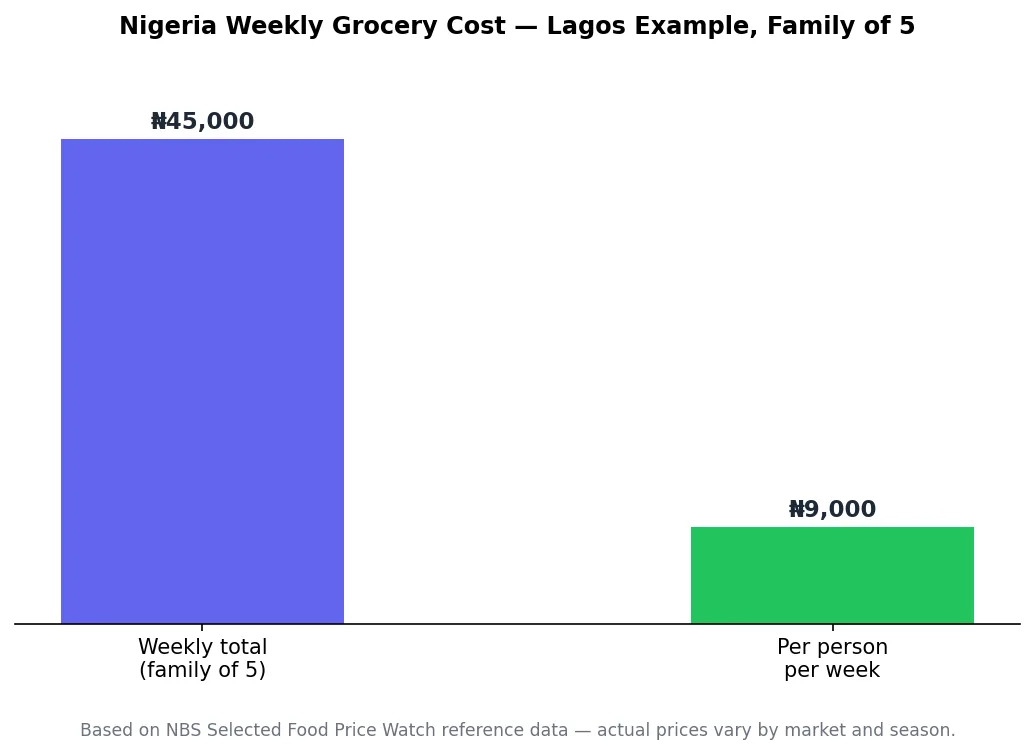
A family of 5 in Lagos builds a weekly list — rice, beans, tomatoes, pepper, protein, and cooking oil — totalling ₦45,000 at Lagos-weighted prices.
- Per person: ₦45,000 ÷ 5 = ₦9,000/week
- With a 10% variability buffer for fresh produce swings: ₦45,000 × 1.10 = ₦49,500
Things to know
- Figures are averaged, historical reference points drawn from NBS Selected Food Price Watch data and market surveys — not a live price feed from a specific market stall.
- Regional gaps are consistent and real: items transported further from production zones, or sold in higher-rent urban markets, routinely command a premium.
- Fresh produce (tomatoes, pepper, onions) is the most volatile category week to week — the variability buffer exists specifically to budget around that, not around staples like rice or garri.
Planning a weekly food budget in Nigeria has become genuinely difficult. Prices for staples like rice, garri, beans, and tomatoes can shift noticeably from one market visit to the next, and the gap between what a family spends in Lagos and what the same basket costs in Kano or Kaduna can run into thousands of naira. A grocery and meal cost estimator exists to make that uncertainty easier to plan around: instead of guessing, you can build a realistic shopping list or select a common Nigerian meal, adjust it for your household size, and see an estimated total before you leave the house.
The starting point for any credible Nigerian food-price tool is the National Bureau of Statistics, which publishes a Selected Food Price Watch report tracking average retail prices for staples such as rice, beans, garri, yam, bread, and proteins across the country's states. This dataset, alongside independent market trackers and vendor surveys in cities like Lagos, Abuja, Kano, and Port Harcourt, forms the backbone of the sample prices used in a calculator like this one. It is important to be precise about what that means: these are averaged, historical reference points, not live quotes pulled from a specific market stall at the moment you open the page. Prices in Mile 12 market in Lagos will differ from prices in Sabon Gari market in Kano on the same day, and both will differ again once you account for whether you are buying wholesale, retail, or from a roadside seller versus a supermarket.
That distinction matters not just for accuracy but for compliance. Under the Federal Competition and Consumer Protection Act (FCCPA) 2018, and under the oversight of the Federal Competition and Consumer Protection Commission (FCCPC), businesses offering pricing information to Nigerian consumers are expected to avoid misleading claims and to present information about goods and services clearly and honestly. A grocery cost calculator that implied its numbers were exact, guaranteed, or sourced live from every market in the country would risk misrepresenting what it actually offers. The honest and useful approach — and the one this tool takes — is to be explicit that every figure is an estimate built from sample, averaged public data, that it will drift from real-world prices as inflation, seasonality, fuel costs, and local supply shift, and that shoppers should treat the output as a planning aid rather than a receipt. That transparency is also good practice under general E-E-A-T principles: naming the data source, dating it clearly, and stating its limitations builds the kind of trustworthiness that both consumers and search engines reward, rather than presenting numbers with false authority.
In practice, the tool works two ways. The first is a build-your-own grocery list: you search or browse items grouped into grains and staples, tubers and plantain, proteins, vegetables and pepper, oils, and a catch-all "others" category for things like seasoning cubes, crayfish, and egusi. Each item carries a sample price per its typical unit — a kilogram of local rice, a crate of eggs, a medium tuber of yam, a litre of palm oil — and a default quantity you can adjust with a simple stepper. As you add items, a running total builds in a summary panel, along with a per-person estimate once you enter your household size.
The second mode covers predefined Nigerian meals: a family-sized pot of jollof rice, eba with egusi soup, a pot of beans porridge, or a simple plate of Indomie and egg for one. Each preset comes with its own ingredient breakdown at a base serving size, and a servings multiplier lets you scale the recipe up or down — doubling the jollof rice recipe for a bigger gathering, or halving the beans porridge for a smaller household — while the calculator recalculates cost and per-person spend automatically.
A location selector lets you weight the estimate toward Lagos, Abuja, Kano, Port Harcourt, or a general national average, since regional price gaps are one of the most consistent patterns in Nigerian food economics; items transported further from production zones, or sold in higher-rent urban markets, routinely command a premium. There is also an optional market variability buffer — a simple percentage you can add on top of the base estimate — for anyone who wants to budget conservatively against the kind of week-to-week price swings that are common with fresh produce like tomatoes, pepper, and onions in particular.
For anyone who wants a rough sense of cost in another currency, the tool can optionally show a reference conversion to US dollars using a free, no-API-key exchange-rate endpoint fetched once when the page loads. If that source is temporarily unavailable, the dollar figure simply does not appear; the naira total, which is the primary output, is unaffected either way, since it is calculated entirely from the tool's own seeded price data rather than depending on any external service.
None of this replaces walking into a market and checking prices yourself, and the tool is upfront about that at both the top of the page and beside the final total. What it offers instead is a fast, structured starting point: a way to sketch a monthly food budget, compare the relative cost of two meal ideas, or work out roughly what feeding a family of five or six will require this week, using data anchored in NBS reporting and real market surveys rather than a wild guess. No account is required, nothing you enter is stored or attached to a profile, and the whole calculation happens in your browser.
Whether you are a student estimating a monthly food allowance, a young family comparing the cost of jollof rice against eba and soup, or someone budgeting for a larger household in a specific city, the grocery and meal cost estimator is built to give you a defensible, clearly-labeled starting number in under a minute.