Ghana Bride Price & Traditional Marriage List Calculator
Plan your Tiri Nsa, knocking list, or traditional marriage budget in Ghana — by ethnic group (Akan, Ewe, Ga-Adangbe, Krobo, northern), itemized and adjustable.
Customs vary widely between and within Ghana's ethnic groups — this uses public averages as a starting point. Select your group for tailored defaults, all of which you can adjust.
Begins with knocking (kokooko) to formally introduce the groom’s intentions, followed by the main engagement day where Tiri Nsa ("head drink" money) and the Akonta Sekan (brother-in-law’s knife fee) are presented alongside cloths and gifts for the bride and her parents.
Planning a Traditional Marriage List in Ghana: What Bride Price Actually Involves
Last updated: August 2026·Reviewed by Kwame Asante, Tax Analyst in Accra·Source
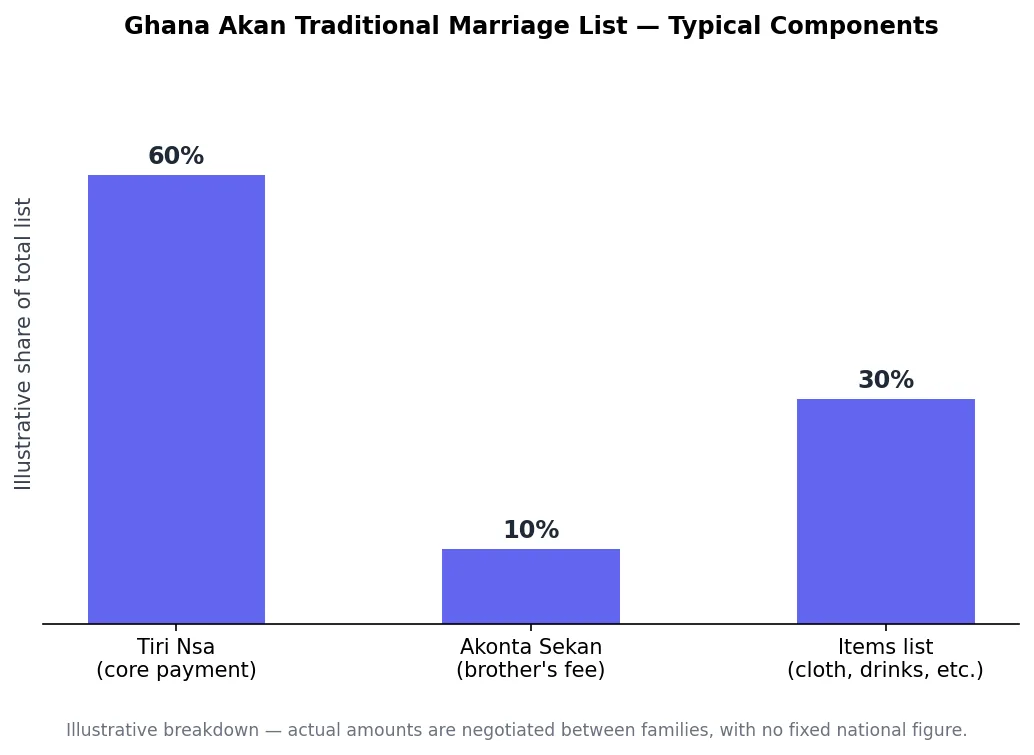
Ghana's traditional marriage list isn't one national standard — Akan, Ewe, Ga-Adangbe, and northern customs each weight different items differently, so a "typical" list from one ethnic group can look quite different from another.
How it's calculated
Total estimate = core payment (e.g. Tiri Nsa) + brother's fee (e.g. Akonta Sekan) + items list (drinks, cloth, jewelry) + ceremony costs, based on the family's ethnic tradition and negotiated scale.
| Ethnic tradition | Distinctive element |
|---|---|
| Akan (Ashanti/Fante) | Tiri Nsa (core payment) + Akonta Sekan (brother's fee) |
| Ewe | Kitchenware often weighted heavily in the list |
| Ga-Adangbe / Krobo | Beadwork given particular emphasis |
| Northern groups | Livestock and kola nuts often more prominent than cash |
Worked example
An Akan traditional marriage list, urban, moderate scale.
- Tiri Nsa (core payment to the father): a negotiated cash sum
- Akonta Sekan (brother's fee): a smaller, separate cash gift
- Items list (cloth, drinks, jewelry): varies by family expectation
Combined cash-and-items totals for urban lists are commonly cited in the tens of thousands of cedis, though rural or more modest lists can be considerably lower — there's no fixed figure, since everything is negotiated between the two families.
Things to know
- Bride price is part of customary marriage rites, Ghana's most common and legally recognized marriage type once essential rites are performed and witnessed — it isn't required for a separate civil or church marriage.
- The knocking (kokooko) ceremony — an initial introduction visit, usually with drinks and a small cash gift — typically precedes the main traditional engagement day.
- A customary marriage can be formally registered under the Customary Marriage and Divorce (Registration) Law, 1985 (PNDCL 112) for stronger legal recognition, particularly useful for inheritance and property matters.
There is no such thing as a standard bride price figure in Ghana, and treating one family's marriage list as a template for another is one of the more common planning mistakes couples make. Bride price here is a deeply meaningful customary practice, not a fixed price tag, and what a given family asks for is shaped as much by their own circumstances and preferences as it is by the broader ethnic tradition they belong to. Going in with a realistic sense of that variability — rather than a single expected number — is the most useful thing you can bring into planning one.
What bride price is not, despite how it sometimes gets described online, is a purchase price for a bride. Within Ghanaian customary law, it functions as a symbol — of respect for the bride's family, of the bonding of two families rather than two individuals, and of the legitimacy it confers on the marriage and any children born of it. Traditional or customary marriages, once the essential rites are performed and properly witnessed by both families, are a legally recognised form of marriage in Ghana, and are in fact the most common type nationally. For couples who want an extra layer of legal certainty on top of the customary rites, Ghana's Customary Marriage and Divorce (Registration) Law, 1985 (PNDCL 112) allows the marriage to be formally registered, which strengthens its legal standing for matters like inheritance and property.
Because there is no national statute fixing bride price amounts or the specific items required, custom does the work that law doesn't — and custom varies significantly by ethnic group. Among the Akan (Ashanti and Fante communities), the process typically opens with knocking, locally called kokooko, where the groom's family formally announces intent, followed by a main engagement day centered on Tiri Nsa — literally "head drink" money — presented to the bride's father, alongside a customary fee for her brother known as Akonta Sekan. Ewe tradition in the Volta region follows a broadly similar knocking-then-engagement structure but commonly folds in household items, kitchenware being a frequently cited inclusion, alongside the drinks and cash components. Ga-Adangbe families in Greater Accra and Krobo families in the Eastern Region share a comparable list structure but place distinctive cultural weight on beadwork, both as gifts and as part of the bride's traditional dress. Among many northern groups, including Dagomba communities, the emphasis shifts further still, with livestock and kola nuts often carrying more customary weight than they do in southern lists.
None of these differences are arbitrary trivia — they matter practically, because assuming one ethnic group's list structure applies to a family from a different tradition is a common and avoidable source of awkwardness during negotiation. If you're marrying into a family whose customs differ from your own, the respectful move is always to ask the family directly (or through the go-between elders customarily involved in these negotiations) what their specific list looks like, rather than assuming a generic template will do.
The financial reality worth being honest about is that traditional marriage lists in urban Ghana have grown noticeably more expensive in recent years, with full lists — cash and items combined — commonly cited in the tens of thousands of cedis for well-resourced urban families, though rural and more modest lists can be considerably lower. Rising costs have prompted public conversation about whether the practice needs updating, but no formal regulation currently caps it. That's precisely why a planning tool that lets you adjust every line item — rather than presenting a single "correct" number — tends to be more useful than a static list: it lets you build toward what your specific families will actually negotiate, informed by common categories (knocking items, the core bride price payment, the bride's personal items, drinks and provisions for the ceremony, and any group-specific inclusions) without pretending there's one right total.
A note on the profile-based adjustments some versions of these calculators include, covering things like the bride's education level or the families' relative social standing: these reflect patterns that do genuinely show up in how some families negotiate, not a rule anyone is obligated to follow, and certainly not a measure of a person's worth. Treat them as optional context, adjustable or ignorable entirely, rather than as inputs a negotiation is required to consider. The only inputs that actually matter in the end are what your two families agree to, in good faith, as fair.