Uganda VAT Calculator: Add & Remove URA VAT (2026)
Calculate uganda vat instantly — add or remove the 18% standard rate from any amount, with a full net, tax and gross breakdown under URA rules.
Advanced: custom rate override
Useful for zero-rated planning or a temporary rate. Overrides the country default and any Ghana component breakdown.
- Net amount (excl. VAT)
- USh1,000.00
- VAT (18.0%)
- USh180.00
- Gross amount (incl. VAT)
- USh1,180.00
- Effective rate used
- 18.0%
Based on Uganda’s standard VAT rate as of 2026. Zero-rated or exempt supplies are not automatically detected — use the custom rate override above if your transaction falls under one.
Uganda VAT Calculator: How URA VAT Is Added and Removed
Last updated: August 2026·Reviewed by Wanjiru Kamau, Tax Analyst in Nairobi·Source
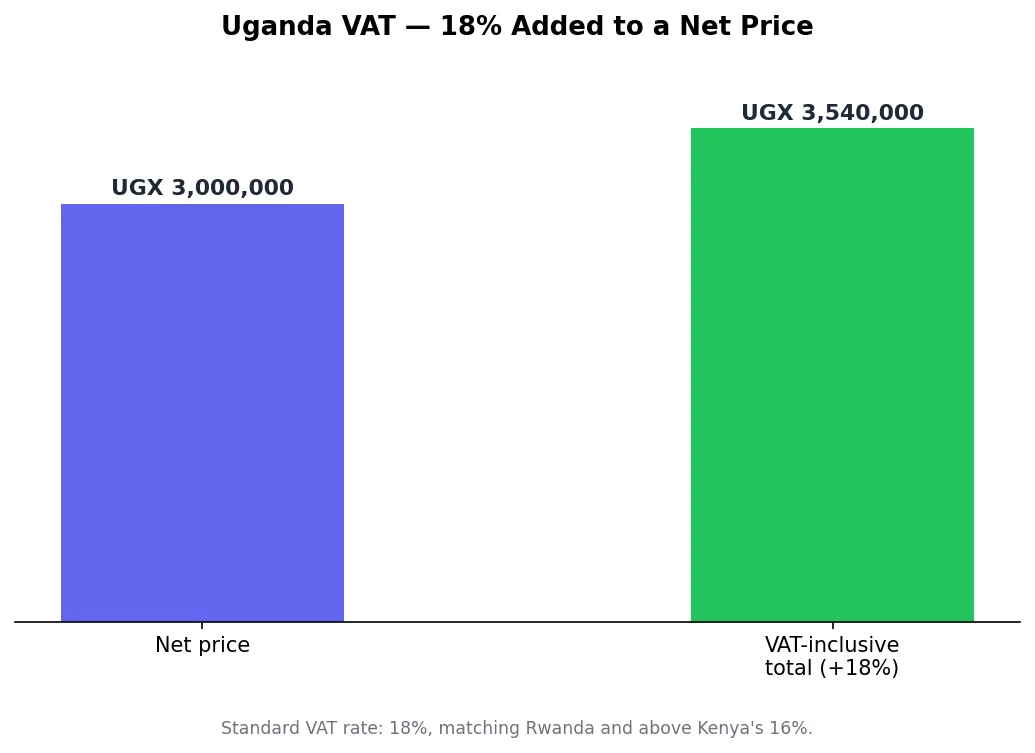
Uganda's 18% VAT rate matches Rwanda's and sits above Kenya's 16% — and since URA's e-invoicing rollout, correctly charging the rate isn't enough on its own for the buyer to reclaim it.
How it's calculated
Adding VAT to a net price is multiplication by 18%. Removing VAT from an inclusive figure requires dividing by 1.18, not subtracting 18% directly, since that percentage was calculated on the smaller net base.
| Task | Formula |
|---|---|
| Add VAT to a net price | Net price × 1.18 |
| Remove VAT from a VAT-inclusive price | Inclusive price ÷ 1.18 |
| VAT registration threshold | UGX 150,000,000 annual taxable turnover |
Worked example
A supplier sells goods for UGX 3,000,000 net.
- VAT (18%): UGX 540,000
- Total invoice: UGX 3,540,000
If a client's budget of UGX 3,540,000 already includes VAT, dividing by 1.18 gives back UGX 3,000,000 net, with the UGX 540,000 difference being VAT owed to URA, not additional fee income.
Things to know
- EFRIS (Electronic Fiscal Receipting and Invoicing Solution) is mandatory for VAT-registered businesses — input VAT can generally only be claimed against an EFRIS-compliant invoice, so invoice format matters as much as the rate charged.
- Registration is mandatory once annual taxable turnover exceeds UGX 150,000,000; voluntary registration is available below that for businesses wanting to reclaim input VAT earlier.
- At 18%, Uganda's rate is meaningfully higher than Kenya's 16% and Nigeria's 7.5% — worth accounting for explicitly when pricing cross-border work.