🇰🇪 Tax

Kenya VAT Calculator: Add & Remove KRA VAT (2026)

Calculate VAT in Kenya instantly — add or remove the 16% standard rate from any amount, with a full breakdown of net, tax and gross under KRA rules.

Advanced: custom rate override

Useful for zero-rated planning or a temporary rate. Overrides the country default and any Ghana component breakdown.

Net amount (excl. VAT)
KSh1,000.00
VAT (16.0%)
KSh160.00
Gross amount (incl. VAT)
KSh1,160.00
Effective rate used
16.0%

Based on Kenya’s standard VAT rate as of 2026. Zero-rated or exempt supplies are not automatically detected — use the custom rate override above if your transaction falls under one.

Kenya VAT Calculator: How KRA VAT Is Added and Removed

Last updated: August 2026·Reviewed by Wanjiru Kamau, Tax Analyst in Nairobi·Source
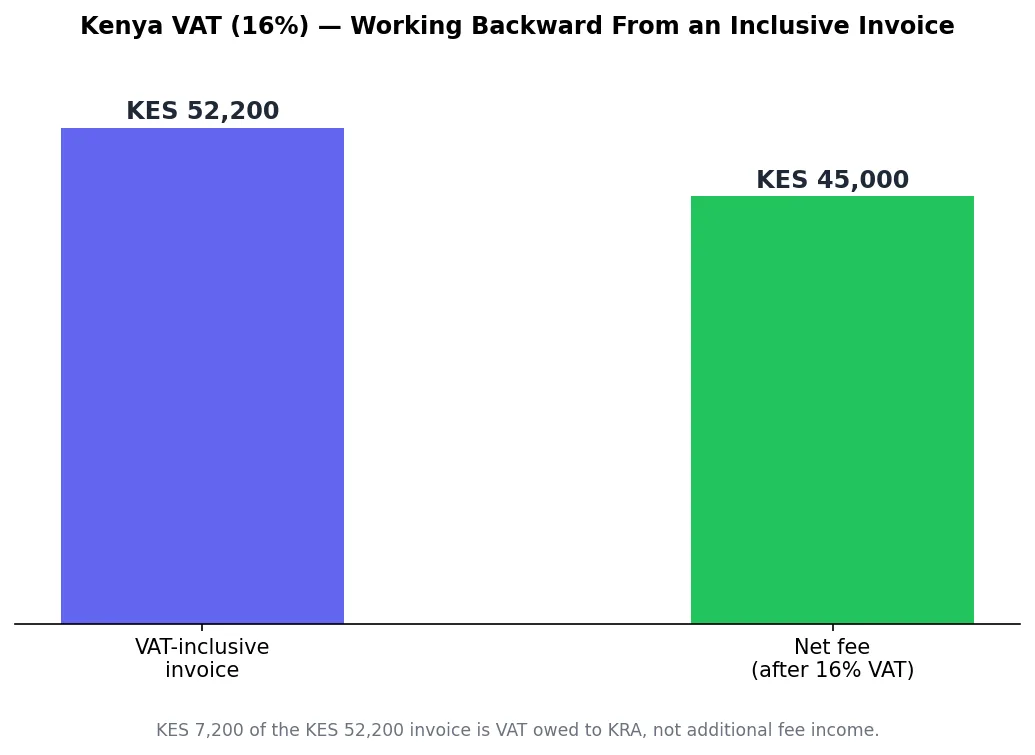
Bar chart comparing a Kenya VAT-inclusive invoice to the net fee after removing 16% VAT

Kenya's standard VAT rate is 16% — but since 2024, correctly charging that rate isn't enough on its own; KRA generally only accepts input VAT claims backed by an eTIMS-compliant invoice.

How it's calculated

Adding VAT to a net price is multiplication by 16%. Removing VAT from an inclusive figure requires dividing by 1.16, not subtracting 16% directly, since the tax was calculated on the smaller net base.

TaskFormula
Add VAT to a net priceNet price × 1.16
Remove VAT from a VAT-inclusive priceInclusive price ÷ 1.16
VAT registration thresholdKES 5,000,000 annual taxable turnover

Worked example

An invoice for KES 52,200 already includes VAT, and you need the fee before tax.

  • Net amount: KES 52,200 ÷ 1.16 = KES 45,000
  • VAT portion: KES 52,200 − KES 45,000 = KES 7,200

So of the KES 52,200 total, KES 7,200 is VAT owed to KRA — the actual service fee is KES 45,000.

Things to know

  • eTIMS (Electronic Tax Invoice Management System) has been mandatory since 2024 — input VAT can generally only be reclaimed against an eTIMS-compliant invoice, so invoice format matters as much as the rate charged.
  • Registration is mandatory once annual taxable turnover exceeds KES 5,000,000; voluntary registration is available below that.
  • A narrower 8% rate has applied at various times to specific petroleum products — it isn't a general reduced rate, and it has changed through successive Finance Acts, so confirm current treatment with KRA before assuming it applies.

Frequently Asked Questions

What is the standard VAT rate in Kenya?+
16%, under the Value Added Tax Act, 2013, administered by KRA. A separate, narrower 8% rate has applied at times to specific petroleum products, not fuel generally.
How do I calculate VAT backwards from a Kenya price that includes tax?+
Divide the gross amount by 1.16 to get the net amount, then subtract net from gross to find the VAT portion. Don't simply subtract 16% from the gross figure directly.
At what turnover does a business need to register for VAT in Kenya?+
Once annual taxable turnover exceeds KES 5 million. Voluntary registration below that threshold is available for businesses that want to reclaim input VAT sooner.
What is eTIMS and why does it matter for VAT?+
eTIMS (Electronic Tax Invoice Management System) is KRA's mandatory e-invoicing system since 2024. Input VAT can generally only be reclaimed against an eTIMS-compliant invoice, so the invoice format matters as much as the rate charged.
Does the 8% fuel VAT rate apply to all petroleum products?+
No — it applies narrowly to specific categories and has changed more than once through successive Finance Acts. Confirm current treatment with KRA before applying it, rather than assuming it covers fuel generally.
If a KES 52,200 invoice includes VAT, what was the fee before tax?+
Divide by 1.16: KES 52,200 ÷ 1.16 = KES 45,000 net, with the KES 7,200 difference being the VAT at the standard 16% rate.
Does the 16% rate apply to all sectors in Kenya?+
Most goods and services are standard-rated at 16%, but Kenya also has zero-rated and exempt categories (certain basic goods, specific financial and educational services) that fall outside the standard calculation -- confirm the category for your specific transaction with KRA.
Can a business operate without eTIMS if it's below the VAT registration threshold?+
eTIMS requirements have broadened over time and can apply to certain businesses even outside standard VAT registration in some cases -- confirm current eTIMS obligations for your specific business size and sector directly with KRA.
Is VAT charged on imported services in Kenya?+
Kenya generally applies VAT on imported services consumed within Kenya through a reverse-charge mechanism, meaning the Kenyan recipient may need to account for the VAT rather than the foreign supplier -- confirm the specific mechanics with KRA for cross-border services.

Related Tools

Related Blog Posts