Ghana PAYE Calculator 2026 — Income Tax & Net Salary Calculator
A Ghana PAYE calculator built on the current GRA tax bands: enter your salary and see your SSNIT deduction, PAYE by band, and net take-home pay.
- Gross employment income
- GHS 5,000.00
- Employee SSNIT/pension
- GHS 275.00
- Chargeable income
- GHS 4,725.00
- PAYE
- GHS 779.75
- Net take-home pay
- GHS 3,945.25
- Effective tax rate
- 15.6%
- Annual gross
- GHS 60,000.00
- Annual net
- GHS 47,343.00
- Employer cost (incl. 13% employer SSNIT)
- GHS 5,650.00
PAYE by band
Good to know
- Bands are progressive — each slice of income is taxed only at its own rate, not your whole income at the top rate you reach.
- Non-residents pay a flat 25% on chargeable income, with no bands.
- SSNIT employee contribution is 5.5% of basic salary, capped at GHS 69,000 monthly insurable earnings, and is deductible before PAYE.
- Personal reliefs reduce tax payable, not chargeable income — actual claims require the relevant GRA form.
Uses the tax bands effective 1 January 2024 under the Income Tax (Amendment) (No. 2) Act, 2023 (Act 1111), as published by the Ghana Revenue Authority — still current as of 2026. For estimation only; confirm with your payslip or a tax practitioner.
Ghana PAYE Calculator: How GRA Actually Works Out Your Tax and Your Take-Home Pay
Last updated: August 2026·Reviewed by Kwame Asante, Tax Analyst in Accra·Source
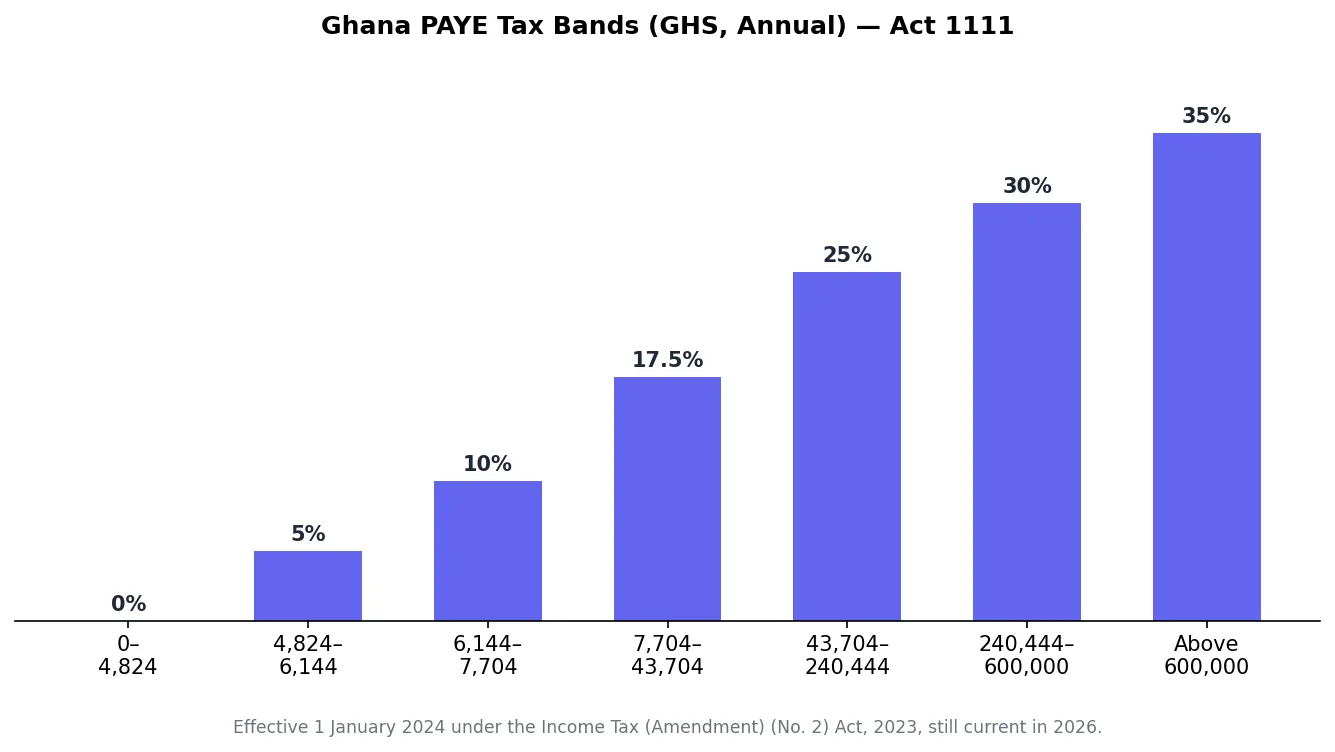
Ghana's PAYE runs on annual bands under Act 1111, and SSNIT comes off first — before the bands are applied — so understanding the order of deductions matters as much as the rates themselves.
How it's calculated
SSNIT (5.5% employee share, capped at GHS 69,000/month insurable earnings) is deducted from gross income first. What's left, minus any personal reliefs you claim, is chargeable income, taxed through Ghana's progressive bands under the Income Tax (Amendment) (No. 2) Act, 2023.
| Chargeable income (annual) | Rate |
|---|---|
| First GHS 4,824 | 0% |
| Next GHS 1,320 | 5% |
| Next GHS 1,560 | 10% |
| Next GHS 36,000 | 17.5% |
| Next GHS 196,740 | 25% |
| Next GHS 359,556 | 30% |
| Above GHS 600,000 | 35% |
Worked example
Ama earns GHS 8,000/month (GHS 96,000/year), with no dependants or additional reliefs claimed.
- SSNIT (5.5%): GHS 5,280/year
- Chargeable income: GHS 96,000 − GHS 5,280 = GHS 90,720
- Tax through the bands: 0% + 5% + 10% + 17.5% on the relevant portions, then 25% on the remainder above GHS 43,704 — totalling ≈ GHS 18,276/year
- Net monthly take-home: ≈ GHS 6,037 (effective rate: ~19%)
Things to know
- Personal reliefs (marriage/responsibility, child education, old age, disability, and others) reduce chargeable income further but must be claimed on the correct GRA form — they aren't automatic.
- A bonus is taxed differently: the lower of the bonus or 15% of annual basic salary is taxed at a flat 5%; anything above that 15% threshold joins ordinary income at the regular bands.
- Non-residents pay a flat 25% on chargeable income, with no progressive bands and none of the resident reliefs or deductions.
Every payslip in Ghana has a PAYE line on it, but very few employees could tell you exactly how that number was reached. Between progressive tax bands, a mandatory SSNIT deduction, and a handful of reliefs almost nobody claims because they don't know they exist, the gap between gross salary and what actually lands in the bank can be confusing even for people who have been earning the same salary for years. This Ghana tax calculator walks through the exact Ghana Revenue Authority income tax calculator methodology GRA itself publishes, band by band, so the number stops feeling like a black box.
Reviewed by Henry Agwu, Chartered Accountant.
Start with the bands themselves, since they're the foundation of any accurate Ghana income tax calculator, and the answer to what the income tax rate in Ghana calculator users see actually is. The current bands took effect on 1 January 2024 under the Income Tax (Amendment) (No. 2) Act, 2023 (Act 1111), and remain the bands published by GRA as of 2026 — this tool uses those bands exactly, not an older or approximated version. On a monthly basis, the first GHS 490 of chargeable income is tax-free, the next GHS 110 is taxed at 5%, the next GHS 130 at 10%, the next roughly GHS 3,166.67 at 17.5%, the next GHS 16,000 at 25%, the next GHS 30,520 at 30%, and everything above roughly GHS 50,416.67 at 35%. Crucially, this is a progressive structure: only each slice of income is taxed at its own rate, not your entire salary at whatever top rate you reach. Someone earning GHS 10,000 a month is not taxed at 25% across the board — only the portion of their income that actually falls in that band is.
Before any of those bands apply, though, your chargeable income needs to be worked out correctly, and this is where a basic salary tax calculator Ghana employees find online, or a simplified paye tax calculator Ghana app, often gets it wrong. Your gross employment income — basic salary plus allowances and taxable benefits like transport, rent, or responsibility allowances — has the employee SSNIT contribution deducted first. A gross salary calculator Ghana workers use for payslip checks should always start from this same figure, before any deduction is applied. That contribution is 5.5% of basic salary, capped at the 2026 maximum insurable earnings of GHS 69,000 a month, and it's the mandatory employee share of the full 18.5% contribution (your employer separately pays the remaining 13%). Optional deductions like mortgage interest on one residential property, Tier-3 provident fund contributions up to 16.5% of basic, and qualifying donations can reduce chargeable income further if they apply to you. Only after all of that is subtracted do the progressive bands actually run, which is what actually determines tax on salary in Ghana for any given month.
There's a second layer many people never claim simply because they don't know it exists: personal reliefs. Unlike the deductions above, reliefs reduce the tax payable itself, after the bands have already been calculated, and they have to be claimed through the relevant GRA form rather than applying automatically. A marriage or responsibility relief of GHS 1,200 a year applies if you have a dependent spouse or two or more children. Child education relief adds GHS 600 a year per child, up to three children. Anyone 60 or older can claim an old age relief of GHS 1,500 a year, and supporting an aged dependant (a relative 60 or older who isn't your spouse or child) adds GHS 1,000 a year, up to two dependants. Disability relief covers 25% of assessable income for a taxpayer with a disability, and training or education costs are deductible up to GHS 2,000 a year. None of these are large individually, but stacked together they can meaningfully change what you actually owe — which is exactly why a proper GRA tax calculator Ghana taxpayers can rely on needs to model them as real options, not bury them.
Bonuses and overtime sit outside the ordinary calculation and follow their own rules. A bonus is taxed at a flat 5% on whichever is lower — the bonus itself or 15% of your annual basic salary — with anything above that 15% threshold folded into your ordinary income and taxed at the regular progressive bands instead. Overtime has an even narrower special rule: it only applies to junior staff whose qualifying annual income doesn't exceed GHS 18,000, in which case up to 50% of monthly basic salary earned as overtime is taxed at 5%, with the excess at 10% for residents (a flat 20% for non-residents). Outside that specific junior-staff threshold, overtime pay is simply added to ordinary income and taxed at the regular bands like any other earnings.
Residency status changes everything about how this works. Non-residents don't use the progressive bands at all — GRA applies a flat 25% to their chargeable income regardless of how much they earn, which is simpler in structure but often a higher effective rate for lower incomes than the graduated bands would produce for a resident.
This tool, functioning as both a payroll calculator Ghana HR teams can sanity-check figures against and a straightforward Ghana salary calculator employees can use on their own payslip, applies every piece of this — the correct progressive bands, the SSNIT cap, optional deductions, personal reliefs, and the bonus and overtime special rules — and shows the full band-by-band breakdown alongside the final net salary calculator Ghana result, so you can see exactly where each cedi of tax came from rather than just trusting a single output figure.