Nigeria VAT Calculator 2026 (7.5% Rate)
Add or extract 7.5% VAT on any amount in naira. Supports standard, zero-rated, and exempt supply types under the Nigeria Tax Act 2025.
Enter an amount to calculate VAT
Nigeria's standard VAT rate is 7.5% under the Nigeria Tax Act 2025 (effective 1 January 2026). Some goods and services are zero-rated or exempt — check the FIRS/NRS guidance or consult an accountant if you're unsure which category applies to your transaction. This calculator is for guidance only and doesn't constitute tax advice.
How VAT Works in Nigeria Under the 2026 Tax Reform
Last updated: August 2026·Reviewed by Chidinma Okafor, Tax Analyst in Lagos·Source
Value Added Tax (VAT) is a consumption tax added at the point of sale — the seller collects it from you and remits it to the government. Nigeria's standard rate has stayed at 7.5% since 2020, including through the Nigeria Tax Act 2025 reform.
How it's calculated
Adding VAT to a net price is straightforward multiplication. Removing VAT from a price that already includes it needs a different formula — dividing by 1.075, not just subtracting 7.5%, because that 7.5% was calculated on a smaller base.
| Task | Formula |
|---|---|
| Add VAT to a net price | Net price × 1.075 |
| Find VAT portion of a net price | Net price × 0.075 |
| Remove VAT from a VAT-inclusive price | Inclusive price ÷ 1.075 |
| Find VAT portion of an inclusive price | Inclusive price − (Inclusive price ÷ 1.075) |
Worked example
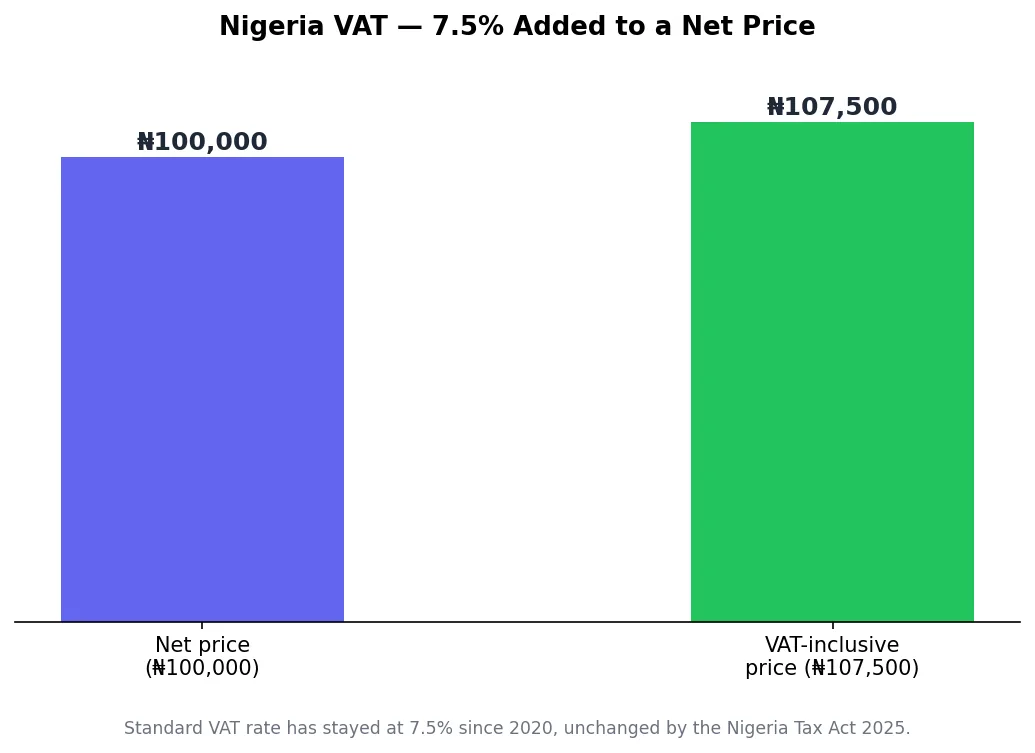
A supplier sells goods for ₦100,000 net (VAT-exclusive).
- VAT to add: ₦100,000 × 7.5% = ₦7,500
- Total invoice: ₦107,500
If instead a customer pays ₦107,500 inclusive of VAT, and you need to work out the net amount:
- Net amount: ₦107,500 ÷ 1.075 = ₦100,000
- VAT portion: ₦107,500 − ₦100,000 = ₦7,500
Things to know
- Businesses must register for VAT once annual turnover exceeds ₦50,000,000 — but small companies (turnover under ₦100m and fixed assets under ₦250m) don't have to charge VAT even if registered.
- Zero-rated and VAT-exempt supplies both mean the customer pays 0% VAT, but they differ for the seller: zero-rated sellers can still reclaim input VAT on their purchases, while exempt sellers generally can't.
- Foreign companies supplying digital services (streaming, software subscriptions) to persons in Nigeria must charge and remit 7.5% VAT, regardless of physical presence in the country.
Nigeria's standard VAT rate has stayed at 7.5% since it was first raised from 5% back in 2020, and it remains at 7.5% under the Nigeria Tax Act (NTA) 2025, which took full effect on 1 January 2026. If you have seen headlines warning of a jump to 10% or even 12.5%, that was an early proposal in the reform bill that lawmakers dropped after public pushback — the rate that actually became law is unchanged.
What did change is which goods and services carry VAT at all. The NTA significantly widened the list of items that are zero-rated or VAT-exempt, specifically to protect household budgets on everyday essentials. From 1 January 2026, basic food items, baby products, locally made sanitary pads, agricultural equipment, and exports are zero-rated, meaning VAT is charged at 0%. Separately, healthcare services and medicines, education services, residential rent, and shared passenger road transport are VAT-exempt, which also works out to 0% charged on the transaction. For everyday consumers, zero-rated and exempt behave the same way at the till — you simply are not charged VAT. The legal distinction between the two mostly matters for VAT-registered businesses claiming back input VAT on their purchases, which this calculator does not attempt to model, since it is built as a straightforward price calculator rather than a filing tool.
Working out VAT is simple once you know which direction you are calculating. If you have a price that excludes VAT and need to add it, multiply the amount by 7.5% to get the VAT, then add that to your original amount to get the VAT-inclusive total. If instead you have a final price that already includes VAT and need to know how much of that was tax, you cannot simply take 7.5% of the total, because that would overstate the VAT. Instead, divide the VAT-inclusive amount by 1.075 to get the net amount, then subtract that from the total to isolate the VAT portion. This calculator handles both directions automatically, so you never have to remember which formula applies.
VAT registration itself is a separate question from how much VAT to charge. Under the NTA, businesses with an annual turnover above ₦50 million must register for VAT with the Nigeria Revenue Service (formerly FIRS) and begin charging it on their taxable supplies, up from the previous ₦25 million threshold. Small companies below that threshold, and specifically those with turnover under ₦100 million and fixed assets under ₦250 million, are exempt from charging VAT even if they voluntarily register, though voluntary registration can still make sense if most of your customers are themselves VAT-registered businesses, since it lets you reclaim input VAT on your own purchases.
One area to watch closely in 2026 is digital services. The NTA extends VAT obligations to foreign companies supplying digital services, streaming, cloud storage, software-as-a-service, and online advertising to persons in Nigeria, regardless of whether that company has any physical presence in the country. Nigerian banks have been designated as collection agents in cases where a foreign provider fails to register directly, meaning the 7.5% VAT may be deducted automatically at the point of payment. If you are a Nigerian business paying a foreign vendor, it is worth confirming whether VAT has already been applied correctly before assuming you can claim it back.
This calculator is a straightforward tool for working out VAT on a specific amount, not a substitute for proper accounting software or professional advice on registration, filing, or input VAT recovery. If you run a VAT-registered business, an accountant or tax adviser familiar with the Nigeria Tax Act 2025 can help make sure your invoicing and filings are fully compliant.