Ghana Land Size Converter — Plots, Acres, m² & Hectares
Convert between Ghana plots, acres, square meters, square feet and hectares — by area value, by dimensions, or by number of plots.
Plot sizes vary by location and seller
"Plot" is not a fixed legal unit under Ghanaian law — it's customary market practice, and sizes vary by area and layout. This tool uses widely accepted standards (70ft × 100ft) for quick reference only. Always confirm the exact dimensions on your survey plan or site plan from a licensed surveyor and the Lands Commission before any transaction. Not legal advice.
Result
Square meters
650.32 m²
Square feet
6,999.99 ft²
Acres
0.1607
Hectares
0.065
Equivalent in common Ghana plot sizes
- Standard Plot (70ft × 100ft) — common in Accra1 plot(s)
- Estate Plot (100ft × 100ft) — e.g. parts of Tema0.7 plot(s)
- Half Plot (70ft × 50ft)2 plot(s)
- Quarter Plot (35ft × 50ft)4 plot(s)
Roughly the size of 0.09 standard football pitch.
Approximation notice: plot-size conversions use the widely cited 70ft × 100ft standard (≈650 m² / ≈0.16 acres) common in Accra and southern Ghana, plus a 100ft × 100ft estate variant seen in some planned layouts (e.g. parts of Tema). Actual plot dimensions vary by location and seller, and no single figure is set in law. 1 acre ≈ 6.2 standard (70×100) plots. For land purchase, mortgage, or legal use, confirm the exact size on your survey plan or indenture from a licensed surveyor and the Lands Commission.
How Many Plots Are in an Acre? Understanding Land Sizes in Ghana
Last updated: August 2026·Reviewed by Kwame Asante, Tax Analyst in Accra·Source
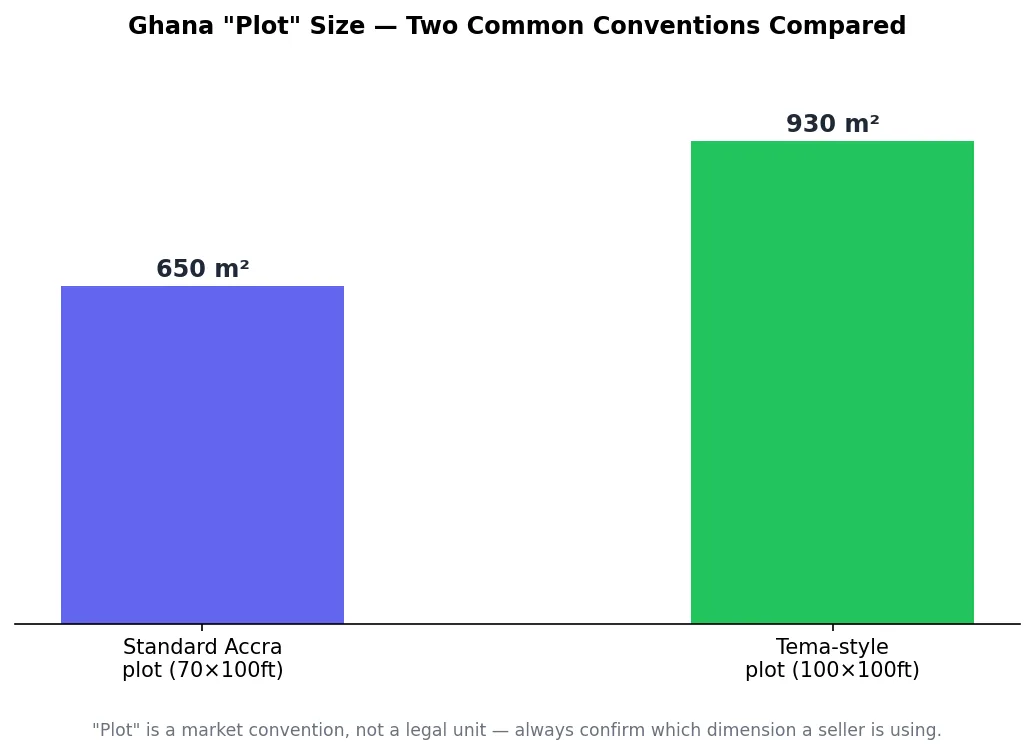
"Plot" isn't a legal unit in Ghana — it's a market convention, and the two most common conventions aren't the same size.
How it's calculated
| Convention | Dimensions | Area (m²) | Acres |
|---|---|---|---|
| Standard Accra plot | 70ft × 100ft | ≈650 m² | ≈0.16 acres |
| Tema-style plot | 100ft × 100ft | ≈930 m² | ≈0.23 acres |
1 acre = 4,046.86 m². At the standard 70×100 convention, that's roughly 6.2 plots to the acre.
Worked example
A seller advertises land as "3 plots" using the standard 70×100 convention.
Area = 3 × 650 m² = 1,950 m²
In acres: 1,950 ÷ 4,046.86 = ≈0.48 acres
In hectares: 1,950 ÷ 10,000 = ≈0.195 hectares
If that same "3 plots" had actually been surveyed on the 100×100 Tema convention instead, the true area would be 2,790 m² — nearly 850 m² more. This is exactly why the underlying dimension matters more than the word "plot" itself.
Things to know
- Always ask which convention a seller is using — 70×100 is the default around Accra, but it's not universal, and nothing in the Land Act 2020 (Act 1036) fixes plot size nationally.
- A licensed surveyor's site plan, stated in square meters, is the only figure with legal certainty. The plot count is shorthand, not a survey result.
- Identical square meterage in a long narrow strip versus a square parcel can suit very different building plans — setback rules eat into a narrow plot's usable space more than they do a square one.
Anyone who has sat through a land negotiation in Ghana has probably heard the word "plot" thrown around as if it were a precise, universally understood unit — the way an acre or a hectare is. It isn't. There is no law that defines exactly how big a plot has to be; it is a customary term shaped by decades of market practice, and it is genuinely useful to know what people usually mean by it before you start comparing prices or reading a site plan.
The dominant convention, especially around Accra and much of southern Ghana, is a plot measuring 70 feet by 100 feet, which works out to roughly 650 square meters, or about 0.16 acres. That figure is common enough that most estate agents, developers, and everyday sellers will assume it unless told otherwise. But it is not the only convention in use. Some planned estates — parts of Tema being a well-known example — lay out plots at 100 feet by 100 feet instead, which comes to roughly 930 square meters, noticeably larger than the standard Accra plot. If nobody tells you which convention a seller is using, you genuinely cannot assume; always ask, and better still, ask to see the site plan.
That site plan matters more than any calculator, including this one. Under the Land Act 2020 (Act 1036), Ghana's framework emphasizes proper surveying and registration through the Lands Commission, and while the Act does not itself mandate a specific plot size, some building regulations reference minimum plot sizes in certain zones — often cited around 450 square meters for residential development, though this varies by district and layout. A licensed surveyor's site plan or indenture is the only document that tells you, with legal certainty, exactly how much land you are dealing with. Everything else, including the "70 by 100" convention this tool defaults to, is a widely accepted shorthand, not a guarantee.
With that caveat out of the way, here is where a converter actually earns its keep: translating between the units people use at different stages of a transaction. A seller might quote a price "per plot." Your bank, your architect, or an import spec sheet might want the figure in acres or hectares. A site plan from a surveyor will usually be in square meters, and older documents sometimes still use square feet. Rather than doing that maths by hand and hoping you remembered the right conversion factor, this tool lets you enter the number in whatever form you have it — a raw area value, a length-by-width dimension, or a plot count — and get every other unit back instantly, including how many standard 70×100 plots that area works out to (roughly 6.2 plots to the acre, for what it's worth).
One extra bit of context worth internalizing: a plot's frontage and depth matter almost as much as its total area when it comes to what you can actually build. Two plots of identical square meterage but very different shapes — a long, narrow strip versus something closer to square — will suit very different kinds of construction, and setback rules can eat into a narrow plot's usable space more aggressively than a square one. This tool converts area cleanly, but it can't tell you whether a given plot's shape works for your building plans; that conversation still belongs with an architect and, again, a licensed surveyor before any money changes hands.
It's also worth knowing where these conventions came from and why they persist. The 70×100 foot figure traces back to colonial-era and early post-independence layout practices in and around Accra, when plots were surveyed and allocated in imperial measurements before Ghana's later shift toward metric units for official documentation. Because so much existing infrastructure — old layout plans, family land records, decades of informal market pricing — is still anchored to that figure, it has simply outlasted the metric transition in everyday use, even though a modern surveyor's site plan will record the actual area in square meters. This is why you'll often see a plot advertised as "70 by 100" in conversation while the accompanying site plan quietly states something like "650.3 m²" — both describe the same convention, just in different units, and neither is more "official" than the other so long as the underlying survey is accurate.
If you're comparing land across different parts of the country, it also pays to search using the terms people actually use locally: "plot of land size Ghana," "how many plots make an acre," "70 by 100 plot," or simply "land conversion Ghana" will generally surface the same customary figures discussed here, while more formal documentation — bank valuations, mortgage paperwork, building permit applications — will almost always default to square meters or hectares. Knowing both "languages," the everyday plot-based one and the formal metric one, and being able to move fluidly between them, is genuinely useful whether you're a first-time buyer sizing up a family compound plot, a developer comparing parcels across Accra, Kumasi, and Takoradi, or simply trying to work out whether a quoted price per plot is actually competitive once converted to a price per square meter.