Kenya Rent Deposit & House-Hunting Budget Calculator 2026
Work out your total move-in cost for renting in Nairobi or elsewhere in Kenya — deposit, advance rent, agent commission, and moving costs — plus an affordability check.
typically KES 15,000–50,000
Affordability check (optional)
- Deposit (2 mo, refundable)
- KES 60,000
- Advance rent (1 mo)
- KES 30,000
- Agent commission
- KES 30,000
- Other upfront (moving, utility deposits, furnishing)
- KES 11,000
- Total cash needed to move in
- KES 131,000
- Monthly housing cost (rent + service charge)
- KES 30,000
What this calculator assumes
- Kenya has no statutory cap on residential deposits (outside old, low-rent controlled tenancies under the Rent Restriction Act) — the deposit/advance figures here are market norms, especially in Nairobi, not legal maximums.
- Deposits should only be reduced for unpaid rent/utilities or documented damage beyond normal wear and tear, with an itemised statement — not for general wear.
- There's no fixed statutory refund deadline; 14–30 days after vacating is the commonly cited reasonable window in tribunal practice.
- Deposit disputes can go to the Small Claims Court (claims up to KES 1,000,000, no lawyer needed) or the Rent Restriction Tribunal for qualifying tenancies.
- Rates outside Nairobi, and in lower-cost Nairobi neighbourhoods, are often lower than the presets shown here — treat these as a starting point, not a quote.
This is a budgeting tool based on common market practice, not legal advice. Always get your tenancy terms in writing, photograph the property's condition at move-in, and pay through traceable methods (M-Pesa/bank transfer) with receipts.
Kenya Rent Deposit Calculator: What Will Moving Into a New Place Actually Cost You?
Last updated: August 2026·Reviewed by Wanjiru Kamau, Tax Analyst in Nairobi·Source
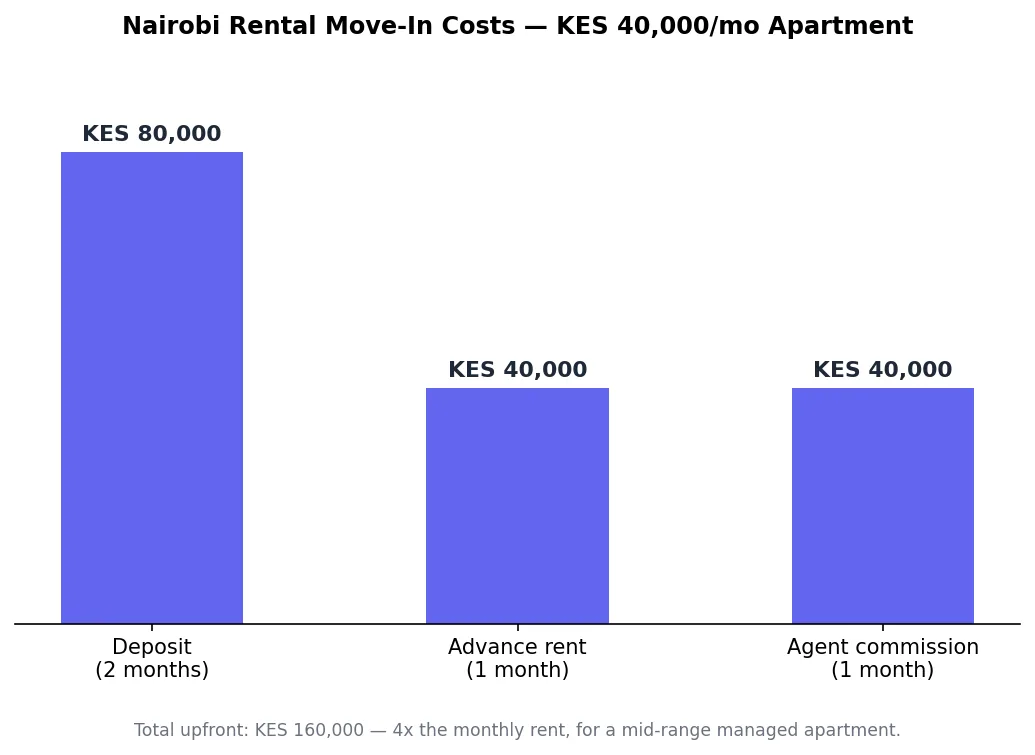
Moving into a new rental in Nairobi typically costs 3-4 months of rent upfront once deposit, advance rent, and agent commission are all added together — not just the one month most first-time renters budget for.
How it's calculated
Total move-in cost = security deposit + one month's advance rent + agent commission (if tenant-paid, common practice). Affordability guideline: rent should generally stay at or under ~30% of monthly income.
| Cost component | Typical amount |
|---|---|
| Security deposit | 1 month (basic units) to 2-3 months (mid-to-high-end managed apartments) |
| Advance rent | 1 month |
| Agent commission (if tenant-paid) | 1 month |
| Total typical upfront | 3-4 months of rent |
Worked example
A KES 40,000/month apartment, mid-range managed building requiring a 2-month deposit, plus standard advance rent and agent commission.
- Deposit (2 months): KES 80,000
- Advance rent (1 month): KES 40,000
- Agent commission (1 month): KES 40,000
- Total upfront needed: KES 160,000 — 4x the monthly rent
Things to know
- There's no legal cap on deposit size — market norms (1 month for basic units, 2-3 for managed apartments) are convention, not law.
- Deposit deductions should only cover unpaid rent/utilities and damage beyond normal wear and tear — ideally backed by an itemised statement.
- For a rent deposit dispute, the Small Claims Court handles claims up to KES 1,000,000 relatively quickly without needing a lawyer; the Rent Restriction Tribunal covers older, rent-controlled tenancies specifically.
Renting a home in Kenya — and in Nairobi especially — almost always costs more upfront than the monthly rent figure on the listing suggests. Between the security deposit, advance rent, agent commission, and the smaller costs of actually moving in, tenants are frequently caught off guard by how much cash they need to have ready on day one. This calculator breaks that total down clearly, using the norms that actually govern Kenya's rental market, so you can budget realistically before you start house-hunting rather than after you've fallen for a place you can't quite afford to move into.
It helps to start with what Kenyan law actually says, because it's less than many tenants assume. There is no single statute in Kenya that caps residential security deposits or requires landlords to place them in a protected scheme, the way some other countries do. What exists instead is a patchwork: the tenancy agreement itself, ordinary contract law, the Rent Restriction Act (Cap 296) — which mainly covers older, low-rent controlled tenancies under roughly KES 2,500 a month and is now rare in Nairobi and other major cities — and a body of common-law and tribunal practice that treats a deposit as held in a kind of trust on the tenant's behalf. In practice, this means deposit amounts are set by the market and the individual landlord, not by a legal ceiling, and while an unusually large deposit could in principle be challenged as unreasonable, there's no fixed number in law that a landlord cannot exceed.
Given that, the figures that matter most to a house-hunter are market norms rather than legal minimums or maximums. In Nairobi, a security deposit of one month's rent is common for basic units, while mid-to-high-end managed apartments in areas like Kilimani, Westlands, and Lavington typically ask for two months, and premium units can occasionally reach three. On top of the deposit, landlords generally expect one month's rent paid in advance, which means a typical move-in already requires two to three months of rent in cash. Add a letting agent's commission — commonly one month's rent, and usually paid by the tenant rather than the landlord — and the realistic total for many Nairobi rentals climbs to three or four months' worth of rent before you've paid for a single box of moving supplies.
Deductions from a deposit are meant to be narrow: unpaid rent or utility bills, and damage to the property beyond ordinary wear and tear, ideally backed by receipts or an itemised statement from the landlord. Normal wear and tear — the everyday marks of having lived somewhere — is not a valid deduction. There is no fixed statutory deadline for returning a deposit once a tenant vacates, but a window of fourteen to thirty days is the figure most commonly cited as reasonable in tribunal practice, and unexplained delays beyond that can support a claim. If a dispute over a deposit does arise, tenants have two main routes: Kenya's Small Claims Court, which handles claims up to KES 1,000,000, moves relatively quickly — often within about sixty days — and doesn't require a lawyer, with a 2025 High Court precedent confirming its jurisdiction over deposit disputes; or the Rent Restriction Tribunal, for tenancies that still qualify under the older rent-control framework.
None of this changes the practical advice that protects tenants best: get every term of the tenancy in a written agreement rather than relying on a verbal understanding, document the property's condition with photos or a written inventory at move-in before you unpack a single item, and pay both the deposit and rent through traceable methods — M-Pesa or bank transfer rather than cash — while keeping receipts for everything. These habits matter more to the outcome of a dispute than any specific number, since Kenya's rental market runs on contract and evidence far more than on statutory deposit caps.
This calculator lets you build your own move-in budget from these norms: set your monthly rent (with quick presets for a bedsitter, one-bedroom, or two-bedroom unit based on typical Nairobi ranges), choose your expected deposit and advance-rent terms, decide whether to include a letting agent's commission, and add moving costs, utility connection deposits, and furnishing estimates. It totals the cash you'll need on move-in day, estimates your ongoing monthly housing cost including a service charge if your building has one, and — if you add your income — checks that rent against the commonly used 30% affordability guideline, flagging whether it looks comfortable or like a stretch. It also estimates how many months it would take to save the full move-in amount at your current surplus, which is often the more useful number when you're planning ahead rather than moving next week. A live USD-to-KES conversion is built in for anyone budgeting from abroad. None of this is legal advice, and actual deposit and advance requirements vary by landlord, building, and area — use it to plan your search, then confirm the real terms in writing before you sign anything.