Pension Calculator Nigeria (2026): Employee & Employer Contributions
Calculate your employee and employer pension contribution in Nigeria under the Pension Reform Act 2014 — 8% employee, 10% employer, paid into your RSA.
Defined by the Pension Reform Act 2014 as Basic + Housing + Transport allowances only. If you don't know that exact split, your full gross monthly salary is a commonly used approximation — check your payslip for the precise figure.
Enter your monthly emolument to calculate
Under the Pension Reform Act 2014, the minimum combined pension contribution is 18% of monthly emolument (8% employee, 10% employer), rising to 20% if the employer elects to bear the full contribution alone. Contributions are paid into your Retirement Savings Account (RSA) with a Pension Fund Administrator (PFA) licensed by the National Pension Commission (PenCom), and employers must remit within 7 days of paying salaries. This calculator is for guidance only — check your RSA statement or PFA for your exact figures.
Pension Calculator Nigeria: How Employee and Employer Contributions Work Under the Pension Reform Act 2014
Last updated: August 2026·Reviewed by Chidinma Okafor, Tax Analyst in Lagos·Source
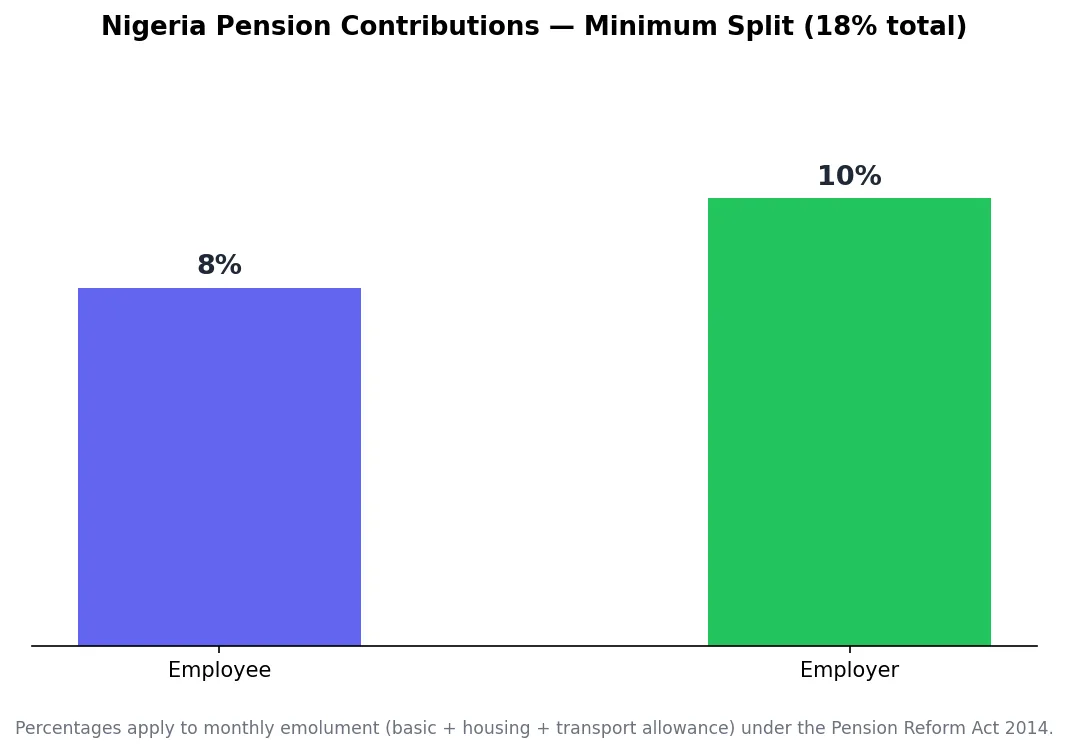
Every payday, a slice of your pay goes into your own Retirement Savings Account (RSA) — matched by a contribution from your employer. This is mandatory for most employers under the Pension Reform Act 2014, and it's separate from PAYE tax.
How it's calculated
Contributions are based on your "monthly emolument" — basic salary plus housing and transport allowances only, not your full gross pay (though many people use gross pay as an approximation when the exact breakdown isn't visible on their payslip).
| Contributor | Minimum rate |
|---|---|
| Employee | 8% of monthly emolument |
| Employer | 10% of monthly emolument |
| Combined minimum | 18% |
| Employer-only (no deduction from staff) | 20% |
Worked example
Ngozi's monthly emolument (basic + housing + transport) is ₦250,000.
- Employee contribution (8%): ₦20,000 — deducted from her pay
- Employer contribution (10%): ₦25,000 — paid on top, by her employer
- Total paid into her RSA each month: ₦45,000
Over a year, that's ₦540,000 building in her retirement account, funded jointly by her and her employer.
Things to know
- Participation is mandatory for employers with 15 or more staff, in both public and private sectors; smaller employers and the self-employed can join voluntarily through a Personal Pension Plan.
- Your employer must remit both contributions to your Pension Fund Administrator (PFA) within 7 working days of paying your salary.
- You can pay in more than the statutory minimum through Additional Voluntary Contributions (AVCs), which remain tax-deductible.
Every payslip in Nigeria that shows a pension deduction is drawing on a single piece of legislation: the Pension Reform Act 2014, signed into law on 1 July 2014, which established the Contributory Pension Scheme (CPS) that replaced the old, unfunded defined-benefit pension arrangements many Nigerians grew up hearing about from their parents' generation. Under the CPS, both you and your employer pay into a personal account that belongs to you for life, rather than a promise from your employer to pay a pension decades later out of whatever budget exists at the time.
The Act sets a minimum combined contribution of 18% of monthly emolument, split as 8% from the employee and 10% from the employer. If an employer chooses to bear the entire contribution alone rather than deduct anything from staff pay, the minimum rises to 20% of monthly emolument, since the Act does not allow the employer's share alone to fall below what the combined 18% would have delivered. Many employers stick to the statutory minimum, but nothing stops an employer or employee from contributing more voluntarily, and those additional voluntary contributions (AVCs) are still tax-deductible provided they go into an approved scheme.
The detail that trips up almost everyone doing this calculation by hand is what "monthly emolument" actually means. It is not your full gross salary. The Act defines it narrowly as the sum of Basic salary, Housing allowance, and Transport allowance only, excluding other allowances like meal subsidies, utilities, leave allowance, or bonuses that many payslips also include. In practice, this means two employees with an identical gross salary of ₦500,000 a month could have quite different pension contributions if their salary structures split Basic, Housing, and Transport differently. If your employer pays you a large chunk of your package as Basic salary and a smaller residual as other allowances, your pension contribution will be closer to being calculated on your full gross pay. If a large share of your package sits in allowances outside Basic, Housing and Transport, your contribution base — and therefore your pension deduction — will be smaller, even on the same total salary.
Because most employees don't have easy visibility into that exact Basic/Housing/Transport split without pulling up their employment contract or asking HR, this calculator accepts whatever figure you enter as your "monthly emolument" input, and gross salary is a commonly used approximation when the precise breakdown isn't known. For an exact figure that matches your actual RSA statement, your payslip or HR department can confirm the true Basic + Housing + Transport total your employer uses.
Participation in the scheme is mandatory for employers with 15 or more employees, covering both public and private sector organisations. Employers with fewer than three employees, and self-employed individuals, are not required to participate but are entitled to join the scheme voluntarily through a Personal Pension Plan, following guidelines issued by the National Pension Commission (PenCom), the federal regulator established to oversee the entire system. PenCom licenses the Pension Fund Administrators (PFAs) who manage individual Retirement Savings Accounts (RSAs), and the Pension Fund Custodians (PFCs) who hold the actual pension assets separately from the PFAs for safekeeping — a structural separation designed specifically to prevent a fund manager from ever having direct custody of the money it manages.
Timing matters too. Section 11 of the Pension Reform Act 2014 requires employers to remit both the employee and employer contributions to the employee's PFA within 7 working days of paying salaries. Persistent late remittance has been a recurring compliance issue flagged by labour groups and even within government payrolls, so if your contributions consistently seem to lag behind your salary payment date by more than a week, it is worth raising directly with your employer or checking your RSA statement through your PFA's online portal.
This calculator gives you a fast way to see exactly how much you and your employer should be contributing each month under the statutory minimums, whether you handle payroll for a small business or simply want to check your own numbers against your payslip. It does not replace a review of your actual RSA statement, which remains the authoritative record of what has actually been remitted on your behalf.