Employee Total Cost Calculator Nigeria (2026) — True Cost of Hiring
See the full cost of hiring an employee in Nigeria — gross salary plus employer pension, NSITF, ITF, and Group Life Insurance.
Scales company-wide totals below.
Pension is calculated on "monthly emolument" — Basic + Housing + Transport only, per the Pension Reform Act 2014 — not full gross pay. Without an exact split, this uses a common 60% / 15% / 10% approximation of gross.
For illustrative/educational purposes. Pension is calculated on an approximated or user-entered Basic + Housing + Transport split (Pension Reform Act 2014); NSITF (Employees' Compensation Act 2010) and ITF (Industrial Training Fund Act, as amended 2011) are shown at their statutory minimums; Group Life Insurance is a simple premium estimate, not an actual quote. Rates and thresholds can change — consult a tax professional, PenCom, NSITF, or the ITF for compliance, and an insurer for an accurate Group Life premium. Not legal or financial advice.
The True Cost of Hiring an Employee in Nigeria: What Employers Actually Pay Beyond Salary
Last updated: August 2026·Reviewed by Chidinma Okafor, Tax Analyst in Lagos·Source
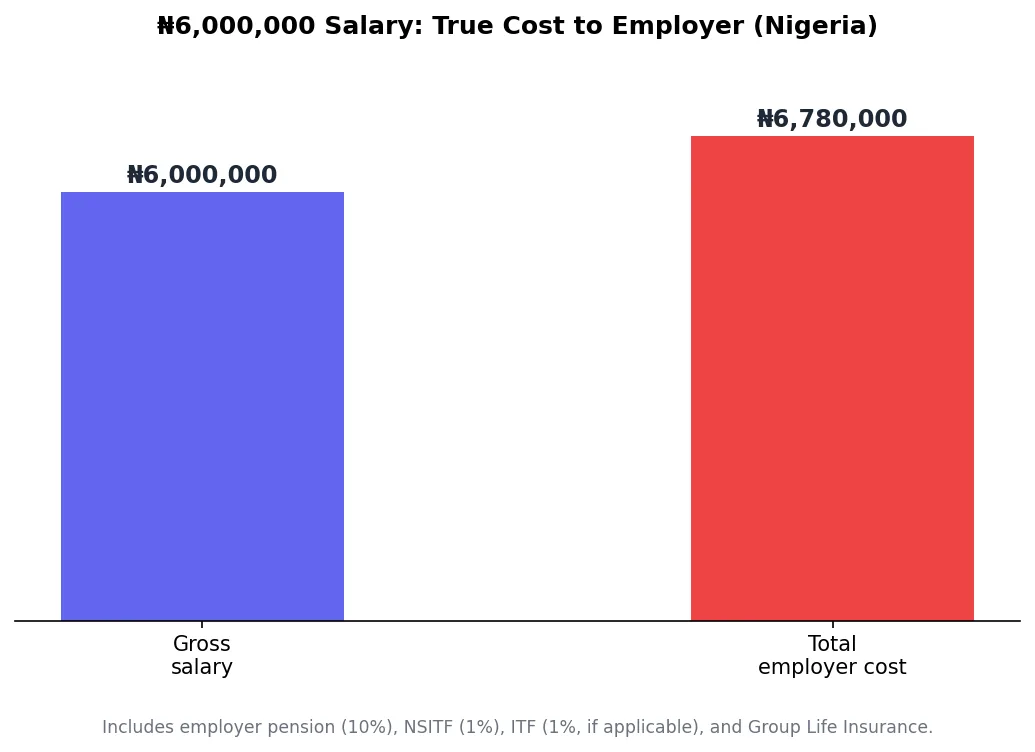
The salary in an offer letter isn't what an employee actually costs a business — statutory employer contributions stack on top, and skipping this calculation is a common reason hiring budgets come in short.
How it's calculated
Beyond gross salary, employers must fund pension (10–20%, depending on structure), NSITF (1%), ITF where applicable (1% of annual payroll, employers with 5+ staff or ₦50m+ turnover), and Group Life Insurance — none of these come out of the employee's pay.
| Employer cost | Rate | Applies to |
|---|---|---|
| Pension (employer share) | 10% (or 20% if bearing full contribution) | All employers |
| NSITF | 1% of payroll | All employers, employer-funded |
| ITF | 1% of annual payroll | Employers with 5+ staff or ₦50m+ turnover |
| Group Life Insurance | Minimum 3x annual emoluments cover | All employers (PRA 2014) |
Worked example
A company offers a new hire ₦500,000/month gross (₦6,000,000/year).
- Employer pension (10%): ₦600,000/year
- NSITF (1%): ₦60,000/year
- ITF (1%, if the company qualifies): ₦60,000/year
- Group Life Insurance (estimated): roughly ₦40,000–₦80,000/year, depending on insurer pricing
- Total employer cost: approximately ₦6,760,000–₦6,800,000/year — about 13–14% above the ₦6,000,000 gross salary
Things to know
- NHF (2.5% of basic) is an employee deduction, not an employer cost — it comes out of the employee's own pay, so it isn't added to total employer cost.
- ITF only applies to employers with 5 or more staff or ₦50,000,000+ annual turnover — smaller businesses aren't liable.
- Total statutory add-ons typically land in the 12–20% range above gross salary, varying with salary structure, headcount, and insurance pricing.
Every offer letter in Nigeria quotes a single number — the monthly or annual gross salary — but that figure is only part of what it actually costs a business to keep someone on payroll. On top of gross pay, Nigerian law obliges employers to fund a stack of statutory contributions that don't appear on the employee's payslip as a deduction, because the employer alone bears them. For a business owner, HR manager, or recruiter building a hiring budget, ignoring these add-ons means underestimating true payroll cost, sometimes by 10% or more per employee. This calculator exists to make that hidden cost visible before the offer goes out, not after the first payroll run.
The single largest employer-only add-on is pension. Under the Pension Reform Act 2014, signed into law on 1 July 2014 and regulated by the National Pension Commission (PenCom), the minimum combined contribution to an employee's Retirement Savings Account (RSA) is 18% of monthly emolument, split as 8% from the employee and 10% from the employer. Crucially, "monthly emolument" is defined narrowly as Basic salary plus Housing and Transport allowances (often shortened to BHT), not the full gross figure — a distinction that changes the math significantly depending on how a company structures its salary components. Some employers choose to bear the entire contribution themselves rather than deduct anything from staff pay; when they do, the Act raises the minimum employer share to 20% of BHT, since the total commitment to the employee's RSA cannot fall below what the standard 18% split would have delivered.
The next add-on is far less well known outside HR and compliance circles: the Nigeria Social Insurance Trust Fund (NSITF) contribution, mandated by the Employees' Compensation Act 2010. This requires employers, across public and private sectors alike, to pay 1% of their total monthly payroll into the Employees' Compensation Fund, which NSITF administers to cover workers who suffer injury, disability, or death in the course of employment. Like pension, it isn't deducted from staff salaries at all — it's a pure employer-side cost, and late or non-remittance attracts a 10% interest penalty on the outstanding amount under NSITF's rules.
A third, conditional add-on is the Industrial Training Fund (ITF) levy. Originally established under the Industrial Training Fund Act of 1971 and substantially amended by the Industrial Training Fund (Amendment) Act 2011, the levy requires any employer with five or more employees, or with an annual turnover of ₦50 million or more (even with fewer staff), to contribute 1% of their total annual payroll to the Fund. Smaller businesses below both thresholds are exempt, which is why this calculator asks for headcount and turnover before flagging whether ITF applies to a given scenario — many small businesses assume they're liable when they aren't, and vice versa. Employers who do fall under the Act can claim a partial refund of up to 50% of their contribution if they run approved staff training programmes during the year, though the claims process has a reputation for being administratively heavy.
A fourth statutory scheme sits in a different category entirely: the National Housing Fund (NHF), created by the National Housing Fund Act of 1992, which requires a 2.5% deduction from an employee's basic salary, remitted to the Federal Mortgage Bank of Nigeria in exchange for eventual access to subsidised housing loans. Unlike pension and NSITF, NHF is an employee deduction, not an employer cost — the employer's obligation is limited to deducting and remitting it correctly, which is why it's shown here for context rather than added to the employer's total. Since the Business Facilitation Act 2023 amended the NHF Act, contribution has become voluntary for private-sector employees, while public-sector staff earning the national minimum wage or more remain required to contribute.
Beyond these four, the Pension Reform Act 2014 also obliges employers to maintain a Group Life Insurance policy for every employee, with a minimum sum assured of three times the employee's total annual emoluments, payable to the employee's designated beneficiaries in the event of death in service. Unlike pension, NSITF, and ITF, there's no fixed statutory percentage for the premium itself — insurers price it based on workforce risk, age profile, and sum assured — so this calculator uses an adjustable estimated-premium percentage rather than a hard-coded rate, and getting an actual quote from a licensed insurer is the only way to know the real figure for a specific workforce.
Put together, gross salary plus employer pension plus NSITF plus (where applicable) ITF plus Group Life Insurance premium gives the real, fully loaded monthly cost of an employee — typically somewhere between 12% and 20% above the quoted gross salary, depending on salary structure, headcount, and whether Group Life is priced conservatively or generously. For a growing Nigerian business budgeting for its next five hires, or an HR team justifying headcount costs to a CFO, that gap between "salary" and "true cost" is exactly the number this tool is built to surface instantly.