Ovulation Calculator South Africa: Fertile Window & Ovulation Day
Find your ovulation day and fertile window from your last period and cycle length — with a 1-3 month calendar view. Educational estimate, not medical advice.
Ovulation Calculator (South Africa)
Estimate your ovulation day and fertile window from your last period and average cycle length.
This is an educational estimate only and is not medical advice. It is not a reliable method of contraception. Individual cycles vary. If you are trying to conceive, have irregular periods, or have any health concerns, please consult a doctor, gynaecologist or fertility clinic in South Africa. Based on the standard calendar method used by South African fertility resources.
Ovulation Calculator South Africa: How Your Fertile Window Is Worked Out
Last updated: August 2026·Reviewed by Dr. Ifeoma Nwachukwu, Health Policy Analyst in Lagos·Source
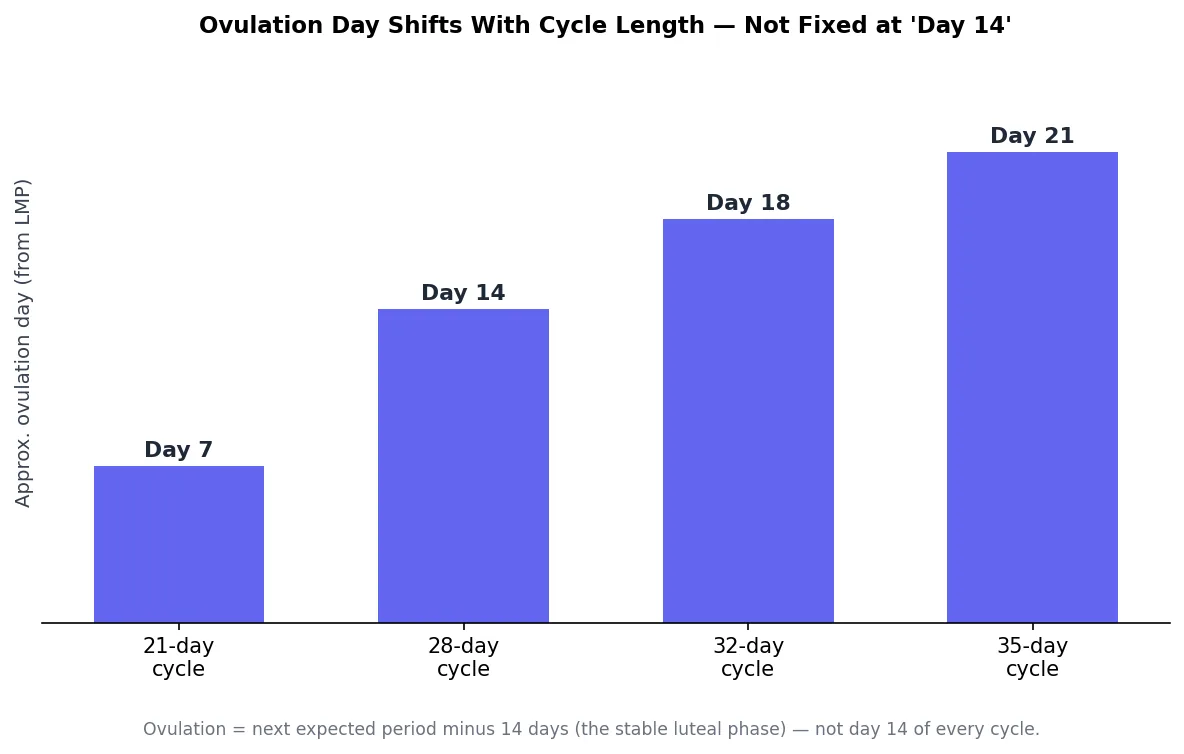
Your fertile window is worked out backward from your next expected period, not forward from day one of your cycle — which is why "day 14" is a myth for most people.
How it's calculated
- Next expected period = LMP + your average cycle length
- Ovulation day = next expected period − 14 days (the luteal phase, which stays fairly fixed at 14 days regardless of overall cycle length)
- Fertile window = the 5 days before ovulation, through ovulation day itself
| Cycle length | Approx. ovulation day (from LMP) |
|---|---|
| 21 days | Day 7 |
| 28 days | Day 14 |
| 32 days | Day 18 |
| 35 days | Day 21 |
Worked example
Lindiwe's last period started on 1 January, and her average cycle is 32 days — longer than the "standard" 28.
Next expected period = 1 Jan + 32 days = 2 February
Ovulation = 2 Feb − 14 days = 19 January
Fertile window = 14 – 19 January
If she'd assumed a flat "day 14" rule instead of using her real cycle length, she'd have missed her actual fertile window by almost a week.
Things to know
- The luteal phase (after ovulation) is the stable part of the cycle; it's the follicular phase (before ovulation) that varies between people and pushes ovulation later in longer cycles.
- This is a calendar estimate, not a diagnostic tool or a method of contraception — South Africa's Department of Health treats calendar-based fertility tools as educational only.
- If cycles are consistently outside the 21–35 day range, or conception isn't happening after several months of trying, the next step is a doctor or fertility clinic, not a more precise calendar.
An ovulation calculator estimates your fertile window and peak ovulation day using the standard calendar method: the first day of your last menstrual period (LMP), plus your average cycle length, minus a typical 14-day luteal phase. This is the same method used by South African fertility resources including Medfem Fertility Clinic, Huggies SA, Fertility Solutions and Marie Stopes SA — there's no country-specific formula or regulation that changes the underlying maths, only consistent guidance on how the results should be presented and used.
How the calculation actually works
Your next expected period is estimated as your last period's start date plus your average cycle length. Ovulation is then placed 14 days before that date — the luteal phase, the time between ovulation and the next period, is usually a fairly fixed 14 days for most women, even when the first half of the cycle (before ovulation) varies considerably from month to month. That's actually the more accurate way to think about ovulation timing: it isn't simply "day 14 of your cycle," it's 14 days before your next period, which can land on a very different day depending on your typical cycle length. Your fertile window is calculated as the five days before ovulation, through ovulation day itself — sperm can survive for several days in the reproductive tract, so intercourse in the days leading up to ovulation can still result in conception even though the egg itself is only viable for about 24 hours after release.
Why your cycle length matters more than a fixed "day 14" rule
A common misconception is that everyone ovulates on day 14 of their cycle. That's only true for someone with an exact 28-day cycle. If your average cycle runs 32 days, your ovulation day shifts later too — roughly day 18, not day 14 — because the luteal phase stays constant at around 14 days while the follicular phase (before ovulation) is what actually varies between women and between cycles. This is why entering your real average cycle length, not assuming everyone is 28 days, meaningfully improves the accuracy of any calendar-based estimate.
What counts as a "normal" cycle
South African fertility resources generally work with the standard adult range of 21 to 35 days for cycle length, with 28 days as the commonly cited average. Cycles outside that range aren't necessarily a problem, but calendar-based predictions become less reliable the further a cycle sits from the typical range, since the standard 14-day luteal-phase assumption may not hold as precisely. If your cycles are consistently outside 21-35 days, or vary a lot from month to month, a calendar estimate like this one is a reasonable starting point, but tracking additional signs (basal body temperature, cervical mucus changes, or an ovulation predictor kit that tests for the LH surge) will generally give you a more precise picture than dates alone.
What this tool is not
This calculator — like every calendar-based ovulation tool, whether from a fertility clinic, a baby-products brand, or a standalone app — is an educational estimate, not a medical device and not a reliable method of contraception. The National Department of Health's guidance on safe conception and contraception treats calendar-based fertile-window tools as self-help/educational only; they are not validated as diagnostic instruments, and individual cycles vary enough from month to month that relying on dates alone to avoid pregnancy carries real risk. If you're actively trying to conceive and it isn't happening after several months of trying with timed intercourse, if your cycles are irregular, or if you have any health concerns related to fertility, the right next step is a conversation with a doctor, gynaecologist, or fertility clinic — not a more precise calculator.
Getting the most out of an estimate like this
Because the fertile window spans roughly six days (five days before ovulation plus ovulation day), most people trying to conceive aim to have regular intercourse across that whole window rather than targeting the single predicted ovulation day exactly — partly because ovulation timing genuinely does shift slightly cycle to cycle even for someone with very regular periods, and partly because sperm survival means the days before ovulation matter just as much as the day itself. Running this calculator for your last 2-3 actual cycles and comparing the predicted windows against how your body actually felt (any noticeable changes around the fertile window) can also help you calibrate how closely your own cycle tracks the standard 14-day luteal-phase assumption this tool uses.
"Ovulation Calculator South Africa" Searches
This is that calculator — enter your cycle details above to estimate your fertile window and ovulation date.