BMI Calculator Nigeria: Free BMI & Body Fat Percentage Calculator
Calculate your BMI and estimate your body fat percentage instantly, free, with results based on WHO categories.
This calculator gives an estimate only and is not a medical diagnosis. BMI does not distinguish muscle from fat and can be less accurate for athletes, older adults, and pregnant women. The body fat estimate is approximate, especially without waist/neck measurements. Always consult a doctor or registered dietitian before making health decisions.
BMI Calculator Nigeria: Understand Your BMI and Body Fat Percentage
Last updated: August 2026·Reviewed by Dr. Ifeoma Nwachukwu, Health Policy Analyst in Lagos·Source
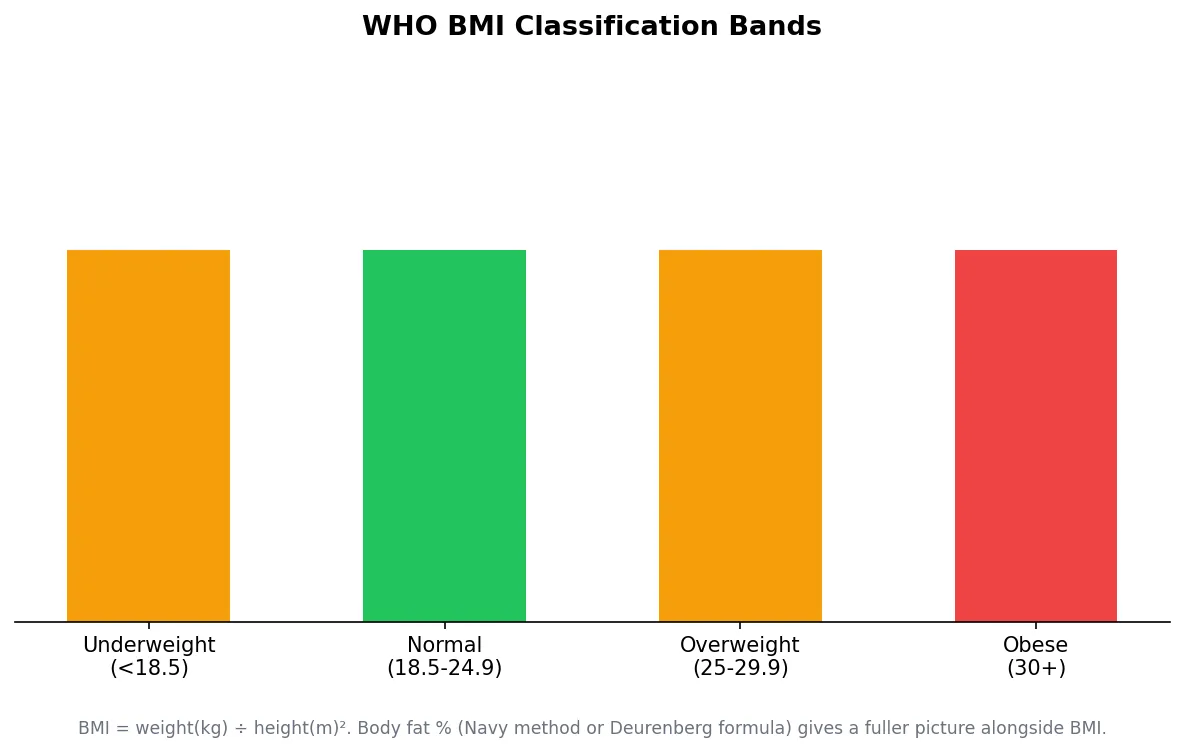
Your BMI is your weight in kilograms divided by your height in metres, squared — a single number that puts you into one of four WHO bands, regardless of how that weight is actually made up.
How it's calculated
| BMI range | WHO classification |
|---|---|
| Below 18.5 | Underweight |
| 18.5 – 24.9 | Normal weight |
| 25 – 29.9 | Overweight |
| 30 and above | Obese |
Body fat percentage uses a separate calculation: the US Navy method (waist, neck, and — for women — hip measurements) if you enter them, or the Deurenberg formula (BMI, age, and sex) if you don't. The Navy method is usually the more useful of the two because it accounts for where fat actually sits on your body, not just your overall weight.
Worked example
Adaeze is 1.65m tall and weighs 68kg.
BMI = 68 ÷ (1.65 × 1.65) = 68 ÷ 2.72 = 25.0
That lands just inside the "overweight" band by WHO's cut-offs. But her waist and neck measurements, run through the Navy method, put her body fat at 24% — within the healthy range for her age. The two numbers don't always point the same way, which is exactly why body fat is worth checking alongside BMI rather than reading BMI alone.
Things to know
- BMI can't tell muscle from fat — a muscular athlete and a sedentary person of the same height and weight can show an identical BMI with very different body compositions.
- The WHO bands were built for general adult populations; they're less reliable for pregnant women, elite athletes, and people under 18.
- Neither number is a diagnosis. If your result sits outside the normal range, or you have health concerns, the useful next step is a conversation with a doctor or dietitian — not a re-calculation.
This BMI calculator Nigeria tool gives you two numbers in seconds: your Body Mass Index and an estimate of your body fat percentage. Both are widely used starting points for understanding weight-related health risk, and both come with real limitations that are worth understanding before you read too much into a single result.
Body Mass Index, or BMI, is a simple ratio of weight to height, calculated as weight in kilograms divided by height in metres squared. It was developed in the 19th century by the Belgian statistician Adolphe Quetelet and later adopted by public health bodies worldwide because it is cheap, fast, and requires no special equipment. The World Health Organization classifies adult BMI into four broad bands: below 18.5 is underweight, 18.5 to 24.9 is normal weight, 25 to 29.9 is overweight, and 30 and above is classified as obese. These bands are used by health ministries and clinics across the world, including in Nigeria, as a first-pass screening tool rather than a diagnosis. A doctor or dietitian will usually combine BMI with other measurements, your medical history, and sometimes lab tests before drawing any conclusion about your health.
Because BMI only looks at weight and height, it cannot tell the difference between muscle and fat. A muscular athlete and a sedentary person of the same height and weight can have identical BMI figures despite very different body compositions. This is one reason body fat percentage is a useful second measurement. Body fat percentage estimates how much of your total body weight is made up of fat tissue versus lean mass such as muscle, bone, and organs. This calculator uses two different approaches depending on what information you provide. If you enter your waist and neck measurements (and hip measurement for women), it applies the United States Navy circumference method, a formula developed for military fitness assessments that estimates body fat from a small number of tape-measure readings. If those measurements are not available, the calculator falls back to the Deurenberg formula, which estimates body fat using BMI, age, and sex. The Navy method tends to be more accurate for most adults because it accounts for fat distribution around the waist, which is a stronger indicator of health risk than weight alone.
For Nigerian users specifically, it helps to view these numbers alongside everyday realities. Diets built around foods like rice, garri, pounded yam, beans, and various soups can vary enormously in calorie density depending on portion size and how much oil is used in preparation. Similarly, lifestyles that involve long commutes and desk-based work in cities like Lagos, Abuja, and Port Harcourt often mean less incidental physical activity than in more rural or physically active occupations. None of this changes the formulas themselves, but it is useful context when thinking about what a BMI or body fat result might mean for you personally, and why two people with the same number can face different practical circumstances.
It is worth being clear about what this tool is not. It is not a diagnostic device, and it is not regulated as a medical device by the National Agency for Food and Drug Administration and Control, NAFDAC, because it does not make any diagnostic or treatment claim. It simply applies published, publicly available formulas to the numbers you provide and displays the result. The tool is not a substitute for a consultation with a doctor, dietitian, or other qualified health professional, particularly if you have an existing health condition, are pregnant, are an elite athlete, or are under 18. BMI and body fat formulas were developed and validated primarily on general adult populations and are known to be less reliable for these groups. If your result places you outside the normal range, or if you have concerns about your weight, waist size, or general health, the right next step is to speak with a healthcare provider, such as a general practitioner at a public or private hospital, who can consider your full medical picture rather than a single calculation.
This calculator is built to be quick, private, and free to use. Nothing you enter is stored or sent anywhere; the calculation happens entirely in your browser. You can switch between metric and imperial units for height and weight, and you can add waist, neck, and hip measurements at any time to get a more precise body fat estimate. Whether you are tracking general fitness progress, curious about where you sit on the WHO BMI scale, or comparing results over time as part of a broader health routine, this tool is designed to give you a fast, clear starting point, with the understanding that the full picture of your health always benefits from professional guidance.
"BMI Calculator Nigeria" Searches
This is that calculator — enter your height and weight above for your BMI and body fat estimate, calculated the same way whether you found this searching "BMI calculator" or "BMI calculator Nigeria."