WAEC / NECO Grade Calculator – Check Credits & O'Level Points (Nigeria)
Enter your WAEC or NECO grades to check your credits, English & Mathematics status, and O'Level points instantly.
Science courses generally require credits in Mathematics and at least two relevant science subjects.
Subjects & grades
2/15Grade Summary
Subjects
2
Credits (A1–C6)
2
English
Credit
Mathematics
Credit
- English Language: C6 (1)
- Mathematics: C6 (1)
This is an unofficial estimation tool based on general publicly available WAEC, NECO, and JAMB admission guidelines. Requirements vary by university, faculty, and admission year. Always verify with JAMB, your target institution, and the official WAEC or NECO result checker. Not affiliated with WAEC, NECO, JAMB, or any Nigerian university. Figures shown are approximations and carry no guarantee of accuracy.
How to Calculate Your WAEC or NECO Grades and O'Level Points for Nigerian University Admission
Last updated: August 2026·Reviewed by Chidinma Okafor, Tax Analyst in Lagos·Source
A "pass" and a "credit" are not the same thing — and the difference decides whether a subject actually counts toward university admission.
How it's calculated
| Grade | % range | Status |
|---|---|---|
| A1 | 75–100% | Excellent (credit) — 6 pts |
| B2 | 70–74% | Very good (credit) — 5 pts |
| B3 | 65–69% | Good (credit) — 4 pts |
| C4–C6 | 50–64% | Credit — 3/2/1 pts |
| D7–E8 | 40–49% | Pass (not a credit) |
| F9 | Below 40% | Fail |
Universities require 5 credits (C6 or better), including English and Mathematics, from no more than 2 sittings. A common aggregate formula: (O'Level points ÷ 30 × 50) + (JAMB score ÷ 8).
Worked example
Amaka's best 5 credits: A1, B2, B3, C4, C5 → points = 6+5+4+3+2 = 20 / 30
Her JAMB score is 250.
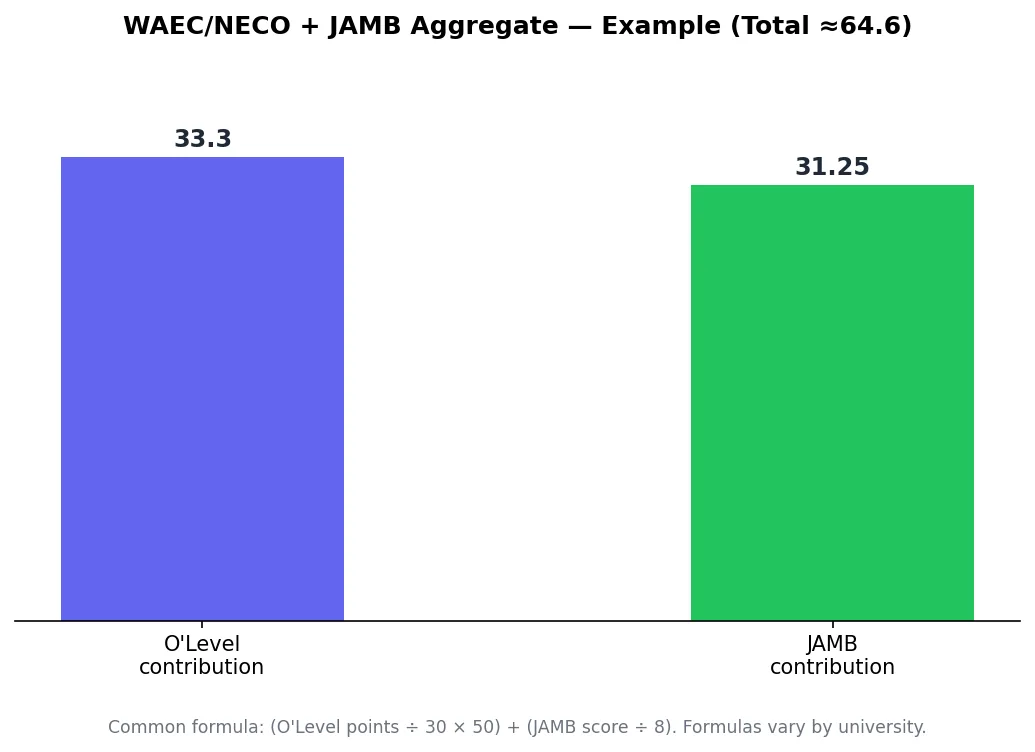
O'Level contribution = (20 ÷ 30) × 50 = 33.3
JAMB contribution = 250 ÷ 8 = 31.25
Estimated aggregate ≈ 64.6
Her D7 in a sixth subject doesn't help or hurt this figure at all — it's simply not a credit, so it's excluded from the calculation entirely.
Things to know
- English and Mathematics must be among your 5 credits regardless of course — a strong overall points total doesn't substitute for these two specifically.
- There's no single national aggregate formula — some universities weight O'Level, JAMB, and Post-UTME as 40/30/30 instead of the pattern above. Check your target institution's brochure.
- Combining a WAEC sitting with a NECO or supplementary sitting is usually accepted, but some competitive faculties penalise or reject two-sitting combinations for certain core subjects — worth confirming directly if your 5 credits span two sittings.
Getting into a Nigerian university starts long before Post-UTME day — it starts with how your WAEC or NECO result is read on paper. Every year, thousands of candidates who scored well individually in each subject are still surprised when a school's admission portal marks them as ineligible, simply because they misunderstood how O'Level grades are converted into the points universities actually screen against. This WAEC NECO grade calculator was built to close that gap: enter the grades from your West African Senior School Certificate Examination (WASSCE) or National Examination Council result, and see instantly how many credits you have, whether your compulsory English Language and Mathematics requirement is satisfied, and how your best five subjects convert into the points scale that most Nigerian universities and polytechnics use during screening.
WAEC and NECO use an identical nine-point grading system for every subject, regardless of which examination body issued the result. A1 and B2 represent excellent and very good performance, B3 is a strong good pass, C4 through C6 are the three credit bands that most institutions treat as functionally equal, D7 and E8 are ordinary passes that do not count as credits for admission purposes, and F9 is an outright fail. This calculator mirrors that official structure exactly, so a C6 in Mathematics is scored the same way a C6 in Physics would be, because that is how the West African Examinations Council itself defines the credit boundary.
The single most common reason candidates get rejected at the screening stage is not a weak overall result — it is missing the specific combination Nigerian universities require: a minimum of five credits, at one or two sittings, which must include English Language and Mathematics. This requirement is not simply a university preference; it reflects long-standing guidance from the National Universities Commission on minimum entry qualifications, and it is echoed by the Joint Admissions and Matriculation Board (JAMB) in its UTME brochure every admission cycle. A candidate with eight credits but a D7 in Mathematics will usually be screened out just as quickly as a candidate with only three credits, because the English and Mathematics requirement is treated as non-negotiable by almost every faculty in the country. This calculator automatically flags both subjects the moment you enter your result, so you know your standing before you ever get near a school portal.
Sittings matter almost as much as subject combination. WAEC and NECO both allow results to be combined from two different exam diets — for example, a candidate who wrote WASSCE in one year and repeated one or two papers the following year. Most universities accept credits combined across two sittings, but a small and growing number of competitive faculties, particularly in Medicine, Law, and Engineering, now insist on a single-sitting result, or apply a points deduction when a combined result is used. Results drawn from three or more sittings are almost never accepted for direct admission screening. The calculator lets you tag each subject by sitting number so you can see immediately whether your combination falls inside the generally accepted range, and it displays a clear warning if it does not.
Beyond raw credit counting, Nigerian universities convert your best five relevant O'Level subjects into a numeric points scale for ranking purposes during Post-UTME and departmental screening: A1 is worth six points, B2 is worth five, B3 is worth four, C4 is worth three, C5 is worth two, and C6 is worth one, with a maximum possible score of thirty points across five subjects. This tool automatically selects your strongest five subjects, prioritising English Language, Mathematics, and whichever subjects are most relevant to your chosen course category — Medicine, Law and Engineering; pure and applied Sciences; Arts; Business and Commercial subjects; or Education — because different faculties weight different O'Level subjects when they build their screening shortlist. A Biology, Chemistry and Physics-heavy combination that looks excellent for a Science-based course may be scored quite differently once relevance to a Law or Arts programme is applied, and the calculator adjusts its best-five selection accordingly whenever you change the course category.
For candidates who already have a JAMB UTME score, the calculator goes a step further and estimates a combined admission aggregate using two of the formulas commonly applied across Nigerian tertiary institutions: a simple model that divides the UTME score by eight and adds it to the O'Level best-five points, and a weighted model used by many universities that runs Post-UTME screening, giving fifty percent weight to the UTME score, thirty percent to the Post-UTME screening score, and twenty percent to the scaled O'Level result. Because every university, and sometimes every faculty within the same university, publishes its own specific cut-off mark and its own exact aggregate formula each admission cycle, the estimate here is intentionally presented as a general range rather than a guarantee, with typical competitive-course aggregates clustering in the mid-sixties to low-eighties out of one hundred.
It is worth being explicit about what this tool is not. It does not connect to WAEC's or NECO's result-checking portals, it does not verify a scratch-card PIN, and it cannot confirm that a result is genuine — that verification can only be done through the official WAEC and NECO result-checking systems, or directly with JAMB during the Direct Entry and UTME registration windows. What this calculator does is take the grades you already know from your result slip and apply the same publicly documented credit rules, points scale, and combination requirements that Nigerian admission officers apply, so you can plan your course applications with a realistic picture of where you stand before spending money and time on a Post-UTME form for a course you may not yet qualify for. Because admission policy, cut-off marks, and departmental requirements change from one JAMB admission cycle to the next, every result here should be treated as a planning estimate, cross-checked against the current UTME brochure and the specific university's own published entry requirements before any final course decision is made.