JAMB Aggregate Score Calculator 2026 | Check Your Admission Chance
Calculate your JAMB aggregate score for UNILAG, UI, OAU, UNN and other Nigerian universities, and estimate your admission chance for your chosen course.
1. Choose university & course
2. Enter your scores
3. O'Level results (best 5 subjects)
Your result
🔴 Low chance for Computer Science at Generic / Standard (50% JAMB + 50% Post-UTME)
Typical aggregate cut-off for this course: around 60 / 100. Estimates only — final admission depends on JAMB CAPS, quotas, catchment area, and the university's official list.
This calculator gives an estimate only, based on publicly reported admission formulas and historical cut-off ranges. Universities update their guidelines yearly — always confirm the exact formula in the institution's current admission brochure and treat the admission chance shown here as a guide, not a guarantee. This tool is not affiliated with JAMB or any university.
JAMB Aggregate Score & Admission Chance Calculator: How It Really Works
Last updated: August 2026·Reviewed by Chidinma Okafor, Tax Analyst in Lagos·Source
JAMB itself doesn't publish one universal aggregate formula — each university sets its own weighting between your UTME score and your Post-UTME/screening score, so the same two scores can produce different aggregates at different schools.
How it's calculated
A common pattern (used generically where a university hasn't published its own weighting) is a straight 50/50 split:
Aggregate = (UTME ÷ 400 × 50) + (Post-UTME ÷ its max score × 50)
| University pattern | UTME weight | Post-UTME weight |
|---|---|---|
| Generic 50/50 | 50% | 50% |
| UNILORIN-style | Lower | Higher |
| ABU-style | Higher | Lower |
| OAU / UI / UNN-style | Also folds in O'Level points | — |
Worked example
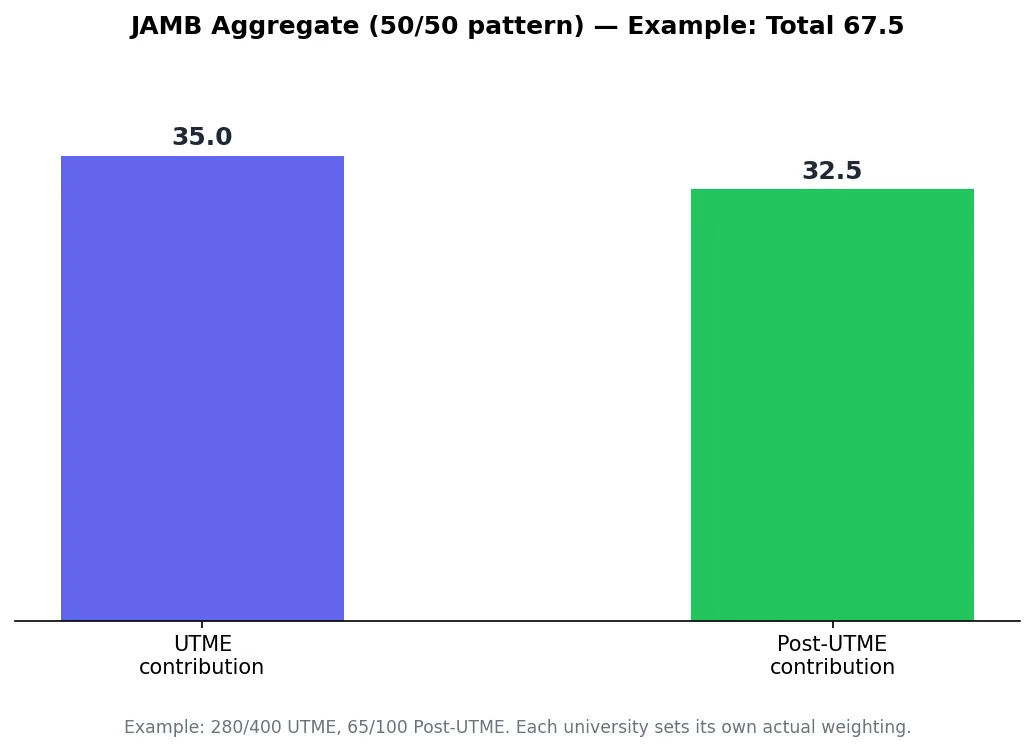
Tunde scores 280/400 in UTME and 65/100 in his university's Post-UTME screening.
UTME contribution = (280 ÷ 400) × 50 = 35.0
Post-UTME contribution = (65 ÷ 100) × 50 = 32.5
Aggregate = 35.0 + 32.5 = 67.5
Against a typical Arts/Humanities cut-off in the high-40s to low-50s, that's competitive. Against Medicine's usual 70–80+ range, it isn't — the same aggregate reads very differently depending on the course.
Things to know
- Post-UTME isn't always out of 100 — University of Ibadan marks out of 50, OAU out of 40, so a raw score means little without knowing the maximum first.
- Eligibility (5 O'Level credits including English and Maths, in ≤2 sittings) is checked separately from the aggregate — a strong aggregate doesn't override a missing required subject.
- Published cut-offs move year to year with applicant volume and quota rules, and final placement runs through JAMB's CAPS system — treat any aggregate calculator, including this one, as a planning estimate, not an admission guarantee.
Every year, well over a million candidates sit the Unified Tertiary Matriculation Examination administered by the Joint Admissions and Matriculation Board, commonly known as JAMB, the federal body established under the JAMB Act (Cap. J1, Laws of the Federation of Nigeria 2004) to regulate admissions into Nigerian tertiary institutions. A JAMB score on its own, however, is rarely the number that decides whether a candidate gets admitted. Most Nigerian universities calculate an aggregate score that blends the UTME result with a Post-UTME or screening score, and in some cases a weighted contribution from O'Level grades, before ranking candidates against a course's cut-off mark. Understanding how this aggregate is built, and where a candidate realistically stands, is one of the most common sources of confusion during admission season, which is exactly what the JAMB Aggregate Score and Admission Chance Calculator on ToolBase is built to clarify.
The starting point is the UTME score itself, marked out of 400 across four subjects. Depending on the institution, this score is scaled down to contribute anywhere from 30 to 60 percent of the final aggregate. The University of Ilorin, for instance, has historically weighted Post-UTME performance more heavily than the UTME score, while Ahmadu Bello University leans the other way, giving the UTME result greater weight. A handful of schools, including Obafemi Awolowo University and the University of Nigeria, Nsukka, also fold in an O'Level component, scoring the best five relevant subjects on the familiar point scale where A1 is worth six points, B2 five, B3 four, C4 three, C5 two, and C6 one, down to zero for anything below a C6. Because these formulas genuinely differ from one institution to the next, and because JAMB itself does not publish a single universal aggregate formula, our calculator lets a candidate pick their target university from a list of the most commonly searched schools, including UNILAG, UI, OAU, UNN, UNIBEN, LASU, ABU, UNILORIN, and UNIPORT, alongside a generic 50/50 option for institutions not yet listed individually.
Post-UTME, more accurately described today as a post-UTME screening or, at many schools, a Direct Entry and screening exercise, is conducted independently by each university under guidelines from the National Universities Commission. Scores are typically out of 100, though some institutions such as the University of Ibadan mark out of 50 and OAU marks out of 40, which is why the calculator asks for the university first and automatically adjusts the expected maximum. Skipping or misjudging this step is one of the most common calculation mistakes candidates make when trying to estimate their own aggregate by hand, since a raw score of 30 out of 40 is a very different contribution from 30 out of 100.
Once the UTME, Post-UTME, and O'Level components are combined, most universities compare the resulting aggregate, usually expressed out of 100, against a cut-off mark for the specific course a candidate applied for. Competitive courses such as Medicine and Surgery, Law, and Pharmacy tend to carry the highest cut-offs, often in the 70 to 80 range or higher in a given admission cycle, while less oversubscribed courses in the Arts and Humanities can admit candidates with aggregates in the high 40s or low 50s. These cut-offs move from year to year based on the volume and strength of applicants, the number of available slots, and quota considerations such as catchment area and educationally less-developed states, so any cut-off figure, including the ones built into this calculator, should be read as a historical guide rather than a fixed target.
Eligibility is a separate hurdle from the aggregate calculation itself. Nigerian universities generally require a minimum of five O'Level credits, including English Language and Mathematics, obtained in no more than two sittings, with the remaining subjects relevant to the intended course. A Computer Science applicant without a credit pass in Mathematics or Physics, for example, is unlikely to be considered regardless of how strong their aggregate looks on paper. The calculator checks the subjects entered against a course's typical requirements and flags any gap immediately, so a candidate can correct course-subject mismatches before relying on the number produced.
It is worth being explicit about what this tool cannot do. Final admission decisions are made through JAMB's Central Admissions Processing System, commonly called CAPS, where universities upload provisional admission lists that candidates must accept or reject within a set window. CAPS decisions take into account quotas, available carry-over capacity, departmental caps, and policy changes that can shift between one admission cycle and the next, none of which any offline calculator can fully anticipate. This tool exists to give a fast, transparent, education-only estimate based on publicly reported formulas and historically observed cut-off ranges, not an official prediction, and it is not affiliated with JAMB, the National Universities Commission, or any individual university. Candidates should always confirm the current formula and cut-off for their specific course in that university's official admission brochure or on the JAMB portal before making decisions about their applications, and should treat every result from this calculator as a planning aid rather than a guarantee of admission.