Zakat Calculator Nigeria 2026 – Calculate Zakat on Cash, Gold & Business Assets
Work out your Zakat in naira using live gold and silver Nisab prices, built for Nigerian Muslims.
Nisab standard
Most scholars recommend the silver standard because it is lower, which brings more wealth into zakat obligation. Some Nigerian zakat committees announce a gold-based figure instead — switch above if that is what your committee uses.
Your assets
Scholars differ on everyday jewellery: some (Hanafi) count it toward zakat, others (many Shafi'i/Maliki/Hanbali views) exempt jewellery in regular personal use. Tick this only if you follow a view that includes it.
Liabilities & deductions
Only debts and bills due immediately or within the near term are deducted here. Long-term obligations (e.g. a multi-year mortgage balance) are generally not deducted in full — only the portion due within the current period.
Your Zakat estimate
- Current Nisab (silver standard)
- ₦0
- Total assets
- ₦0
- Total deductions
- −₦0
- Net zakatable wealth
- ₦0
- Meets Nisab?
- No
Zakat due (2.5%)
₦0
Zakat is only obligatory once qualifying wealth has stayed at or above the Nisab for one full lunar year (Hawl, ≈354 days). This tool does not track your Hawl date automatically — check your estimate against the anniversary of when your wealth first reached Nisab.
This calculator gives an estimate for planning purposes only, based on standard Nisab weights (87.48g gold / 612.36g silver) and approximate live market prices converted to naira. It is not religious guidance. For zakat obligations on complex assets (mixed business inventory, agricultural produce, livestock, or disputed receivables), confirm with a qualified scholar or your local zakat committee before paying.
Zakat Calculator for Nigeria: Nisab, Assets, and What You Actually Owe
Last updated: August 2026·Reviewed by Imam Abdullahi Bello, Islamic Studies Reviewer·Source
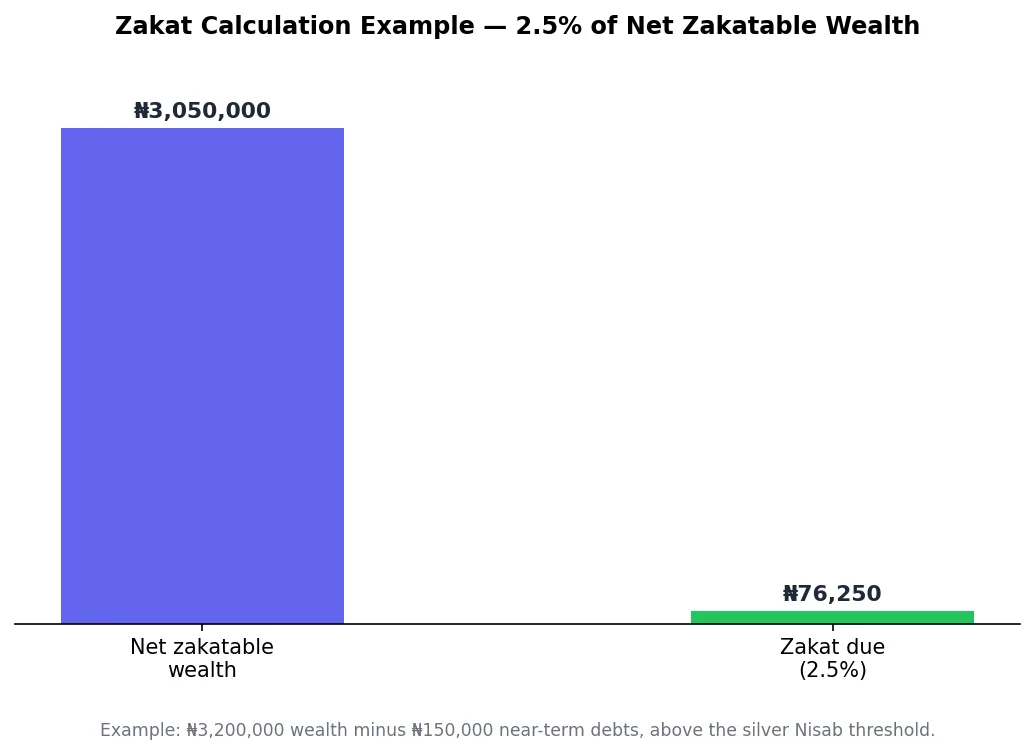
Zakat is fixed at 2.5% of net zakatable wealth — but only once that wealth has stayed at or above the Nisab threshold for a full lunar year (Hawl).
Nisab: two standards
| Standard | Weight | Effect |
|---|---|---|
| Gold | 87.48g pure gold | Higher naira threshold |
| Silver | 612.36g silver | Lower threshold — more people qualify |
Worked example
A trader holds ₦3,200,000 in cash and business inventory, with ₦150,000 in near-term debts due.
- Net zakatable wealth: ₦3,200,000 − ₦150,000 = ₦3,050,000
- If silver Nisab (at current prices) is roughly ₦850,000, the trader's wealth clears the threshold.
- Zakat due: ₦3,050,000 × 2.5% = ₦76,250
Things to know
- Only debts due immediately or in the near term are deducted before applying the 2.5% rate — a multi-year loan's full outstanding balance generally isn't deducted under most contemporary fiqh rulings.
- Personal-use items (your home, car, household goods) are excluded entirely; Zakat applies to wealth held for growth or exchange.
- Nisab values move with live gold/silver prices and the exchange rate — a Zakat estimate using stale prices from months ago can meaningfully under- or overstate what's owed.
Zakat is one of the five pillars of Islam, and for Muslims in Nigeria, working out exactly how much is owed each year is often the hardest part of fulfilling the obligation. This Zakat calculator is built specifically for the Nigerian context, converting your assets into naira and comparing them against the current Nisab threshold so you can see, in one sitting, whether Zakat is due and how much to pay.
At its core, the Zakat rate is fixed: 2.5 percent, or one-fortieth, of net zakatable wealth, provided that wealth has remained at or above the Nisab threshold for one full lunar year, known as the Hawl (approximately 354 days on the Islamic calendar). The Hawl matters because Zakat is not a one-off snapshot tax on whatever you happen to hold today — it is a yearly obligation tied to sustained wealth. If your qualifying assets dipped below Nisab at some point during the year and only recovered recently, most scholars hold that the Hawl restarts from the point your wealth met Nisab again. This calculator flags the Hawl requirement clearly but, like most self-service Zakat tools, leaves tracking your personal anniversary date to you, since that depends on when your own wealth first reached the threshold.
Nisab itself is calculated two ways, and this is where a lot of confusion happens. The gold standard sets Nisab at 87.48 grams of pure (24-karat) gold, while the silver standard sets it at 612.36 grams of silver. Because silver is worth far less per gram than gold, the silver Nisab produces a lower naira threshold, which means more people qualify to pay Zakat and more wealth is redistributed — this is why many contemporary scholars, including bodies associated with the Fiqh Council and mainstream Hanafi and Shafi'i scholarship, recommend defaulting to the silver standard for broader inclusion. That said, some Nigerian zakat-collecting bodies, including state-level Zakat and Hubsi/Sadaqah Commissions such as those operating in Kano, Zamfara, and Sokoto States, and umbrella organisations like the Nigerian Supreme Council for Islamic Affairs (NSCIA) and Jama'atu Nasril Islam (JNI), reference gold-based figures in their public Nisab announcements. Because there is no single national Zakat authority with binding legal force in Nigeria's secular system, this calculator lets you toggle between both standards rather than forcing one, and displays whichever live figure you choose alongside a short explanation of the difference.
To get an accurate Nisab value in naira, the calculator pulls live gold and silver spot prices in US dollars per ounce and a live USD-to-NGN exchange rate, converts the spot price to a per-gram naira figure, then multiplies by the relevant Nisab weight. This matters because gold and silver prices move constantly, and a Zakat calculator using stale, hardcoded prices from months ago can under- or over-estimate what you owe by a significant margin, especially during periods of naira volatility. If the live price sources are temporarily unreachable, the tool automatically falls back to a clearly labelled static reference price rather than failing outright, and shows a visible notice recommending you refresh or check current prices with your local Zakat committee before finalising payment — accuracy claims should never outrun what the underlying data can actually support.
On the asset side, the calculator covers the categories most relevant to a typical Nigerian Muslim's balance sheet: cash and bank balances, mobile money and digital wallet balances, gold and silver (split between savings/investment holdings and personally worn jewellery, since scholars disagree on whether everyday jewellery is zakatable), business inventory and trade goods at current market value, investments such as shares or zakatable crypto holdings, money owed to you that you reasonably expect to recover, and other income due, such as outstanding rent. Personal-use items like your home, car, and household goods are excluded entirely, in line with the general Sharia principle that Zakat applies to wealth held for growth or exchange, not to items used for basic living.
On the liabilities side, only debts and bills that are due immediately or in the very near term are deducted from your total assets before the 2.5 percent rate is applied. Long-term obligations, such as the outstanding balance on a multi-year loan, are generally not deducted in full under most contemporary fiqh rulings, since only the portion currently due represents an immediate reduction in disposable wealth. This distinction trips up a lot of first-time Zakat payers who assume their entire mortgage or business loan balance should be subtracted.
It's worth being direct about the limits of any digital Zakat calculator, including this one. Zakat in Nigeria is a religious obligation, not something with a statutory basis or state-enforced compliance mechanism (unlike, for example, Personal Income Tax under Nigeria's Personal Income Tax Act), so no calculator can give you a legally authoritative figure. What this tool can do is apply the standard, widely accepted formulas — the 2.5 percent rate, both Nisab standards, purity-adjusted gold weights, and category-appropriate deductions — consistently and transparently, using live market data converted to naira, so you have a solid, well-reasoned starting estimate. For unusual situations, such as mixed business partnerships, agricultural Zakat (Ushr), livestock, or disputed receivables you're not confident you'll recover, it remains best practice to confirm your final figure with a qualified scholar or a recognised Zakat-collecting body in your state before you pay.