Catfish Farming Break-Even Calculator Nigeria 2026 — Profit & Cost Calculator
A free catfish farming break-even calculator for Nigeria: enter your stocking, feed, and cost figures to see break-even price per kg, cost of production, ROI, and profit margin for your grow-out cycle.
Production Scale
Costs
Revenue Assumptions
Your results
Net Profit/Loss (this cycle)
₦65,500
Break-even selling price/kg
₦2,923
Cost of production per kg
₦2,923
ROI
2.6%
Profit margin
2.6%
Total investment (this cycle)
₦2,484,500
Fish harvested
850
Total harvest weight
850 kg
Total feed used
1,105 kg
Break-even analysis
At your entered selling price of ₦3,000/kg, you need to sell at least 829 fish (about 828.2 kg) to cover your total cost of ₦2,484,500. Below ₦2,923/kg, this cycle runs at a loss regardless of volume.
Cost breakdown
Annual projection (× 1.5 cycles/year)
Assumes recurring costs repeat each cycle and setup cost is a one-time expense for the year — adjust cycles per year to match how many grow-outs your pond/tank realistically supports.
Sensitivity: what moves your profit
| Scenario | Net profit (₦) |
|---|---|
| Base case | ₦65,500 |
| Feed price +20% | ₦-354,400 |
| Feed price -20% | ₦485,400 |
| Selling price +10% | ₦320,500 |
| Selling price -10% | ₦-189,500 |
Nigeria averages used (2025–2026 market guidance)
- Fingerlings/juveniles: typically ₦40–₦100 each, with quality stock around ₦50–₦80 — common across fish farming clusters like Lagos, Ibadan and Ogun State.
- Feed: a 15kg bag of mid-range floating feed commonly runs ₦22,000–₦36,000; feed is usually 60–70%+ of total operating cost for catfish in Nigeria.
- FCR (feed conversion ratio): 1.2–1.5 is typical with quality floating feed; sinking or local feed and poorer management push this higher.
- Survival: 80–90% is realistic for a well-managed pond or tank; 85% is a reasonable planning default.
- Farm-gate selling price: roughly ₦2,500–₦3,500/kg, with Lagos and Abuja averaging around ₦3,000/kg in early 2026 — prices vary by season, size and buyer type (market women vs restaurants).
- Cycle length: 5–6 months is typical to reach table size (about 1–1.2kg); well-run operations can manage roughly two cycles a year.
Figures are planning estimates based on typical Nigerian catfish (Clarias gariepinus) grow-out — for fish farming in Lagos, fish farming in Ibadan, and catfish farms across Nigeria generally. Update the inputs with your own supplier and buyer quotes, since prices move with FX rates and inflation. Feed is usually 60–70% of total cost, and survival rate plus FCR are the two biggest drivers of profitability. This tool is not financial, veterinary, or legal advice.
Small-to-medium private catfish ponds and tanks are common and largely unregulated beyond general business registration. Larger or more intensive commercial operations may need Corporate Affairs Commission (CAC) registration, environmental (EIA) clearance, and aquaculture licensing through the Federal Department of Fisheries & Aquaculture or your state ministry of agriculture — confirm current requirements before scaling up.
Catfish Farming Break-Even Calculator: What It Really Costs to Turn a Profit in Nigeria
Last updated: August 2026·Reviewed by Dr. Ifeoma Nwachukwu, Health Policy Analyst in Lagos·Source
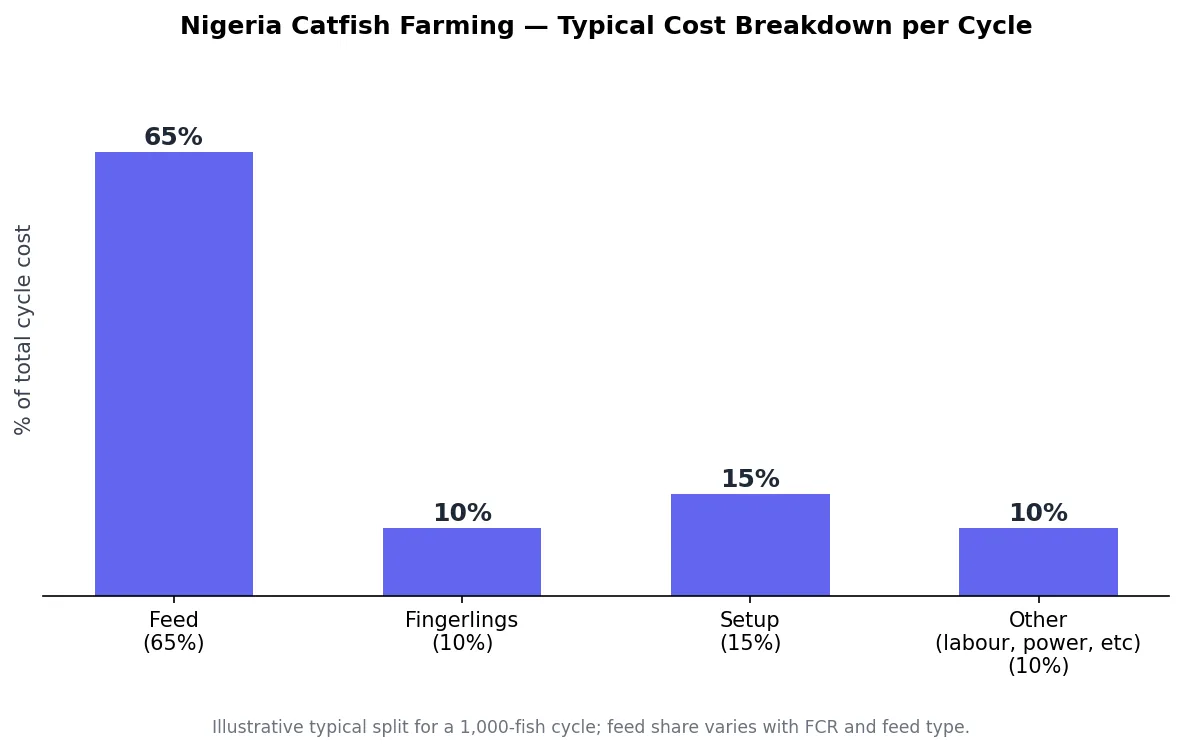
Catfish farming looks straightforward on paper, but feed alone typically eats 60–70% of total production cost — get the feed conversion ratio wrong and a cycle that looked profitable on a spreadsheet loses money in the pond.
How it's calculated
Break-even price per kg is your total cost for the cycle (fingerlings, feed, setup, labour, water/power, medications, transport) divided by total harvest weight. Feed quantity itself is driven by your Feed Conversion Ratio (FCR) — how many kg of feed it takes to produce 1kg of fish.
| Input | Typical range | Notes |
|---|---|---|
| FCR | 1.2 – 1.5 | Lower is better; quality floating feed performs best |
| Survival rate | 80% – 90% | 85% is a reasonable planning default |
| Feed share of total cost | 60% – 70% | The dominant cost driver |
| Cycle length (to 1.0–1.2kg table size) | 5 – 6 months | Up to 2 cycles/year achievable |
Worked example
1,000 fingerlings stocked, 85% survival, target 1.0kg harvest weight, FCR of 1.4.
- Fish harvested: 1,000 × 85% = 850 fish
- Total harvest weight: 850 × 1.0kg = 850kg
- Feed needed: 850kg × 1.4 FCR = 1,190kg (≈1.2 tonnes)
- If total cycle cost (fingerlings + feed + setup + other) is ₦2,000,000, break-even price: ₦2,000,000 ÷ 850kg = ₦2,353/kg
At a farm-gate price of ₦3,000/kg, this cycle would return a profit of roughly ₦647 per kg, or about ₦550,000 total.
Things to know
- A higher FCR (more feed needed per kg of fish) usually signals sinking/local feed, poor water quality, or management issues — it directly raises cost per kilogram.
- Farm-gate prices vary by season, fish size, and buyer type — market women typically pay less than restaurants or direct retail buyers.
- Small private ponds are largely unregulated beyond general business registration; larger commercial operations may need CAC registration and aquaculture licensing.
Catfish farming in Nigeria looks deceptively simple from the outside — stock some juveniles, feed them for a few months, sell at table size — but the gap between farmers who profit and farmers who barely break even almost always comes down to numbers most people never actually sit down and calculate. This catfish farming break-even calculator exists for exactly that reason: to turn survival rate, feed conversion, and farm-gate prices into a clear picture of what a cycle actually costs you, and what price you need to hit just to cover it.
Start with why cat fish farming in Nigeria has become such a common small-business path in the first place. Clarias gariepinus — African catfish — tolerates the crowded, sometimes inconsistent water conditions of a backyard tarpaulin pond or concrete tank far better than most fish species, grows to table size in roughly 5 to 6 months, and sells into a steady, culturally embedded demand across the country. Fish farming in Lagos and fish farming in Ibadan are two of the most visible clusters — dense urban demand paired with accessible feed and fingerling supply chains — but catfish in Nigeria is realistically a nationwide business, from backyard operations feeding a single household's income to medium commercial setups running several thousand fish per cycle.
The biology drives the economics more directly here than in most livestock enterprises, so the calculator starts there. Stock a known number of fingerlings or juveniles, apply a realistic survival rate — 80–90% is achievable with decent water management and biosecurity, with 85% a sensible planning default — and that gives you your harvested fish count. Multiply by an average harvest weight, typically 1.0 to 1.2kg at table size, and you have your total harvest weight in kilograms, which is the number every cost and revenue figure downstream actually depends on.
Feed is where catfish farming profit is won or lost, which is why how much to start catfish farming calculator searches so often circle back to feed cost specifically. Feed typically accounts for 60% to 70%-plus of total operating cost, and the driver behind that cost is the feed conversion ratio (FCR) — how many kilograms of feed it takes to produce one kilogram of fish. A well-managed pond on quality floating feed runs an FCR of roughly 1.2 to 1.5; poorer management, or switching to cheaper sinking or local feed, pushes that ratio — and your total feed bill — considerably higher. A 15kg bag of mid-range floating feed commonly costs ₦22,000 to ₦36,000 in the current Nigerian market, and for a standard 1,000-fish cycle, total feed consumption often lands between 1.0 and 1.4 tonnes. This calculator lets you compute feed cost automatically from FCR and price per kilogram, or enter a known total directly if you already have supplier quotes.
Beyond feed, the remaining catfish farming cost in Nigeria breaks into a handful of predictable categories: fingerlings or juveniles, typically ₦40 to ₦100 each depending on quality and source; pond or tank setup, where a tarpaulin pond is the cheapest entry point and concrete construction costs considerably more but lasts longer; labour; water, pumping, and electricity or fuel for aeration and circulation; medications and water-quality treatments; and transport, marketing, and harvesting costs. None of these individually rivals feed, but together they shape whether a cycle that looks profitable on paper for a catfish farm in Nigeria actually is once every line item is accounted for.
Revenue is the other half of the equation, and it hinges on the farm-gate selling price per kilogram — the price a farmer actually receives, not the retail price a consumer eventually pays. That figure runs roughly ₦2,500 to ₦3,500 per kilogram depending on season, size, and buyer — market women typically pay less than restaurants and direct retail buyers — with Lagos and Abuja averaging around ₦3,000/kg in early 2026. This calculator uses your entered price to work out gross revenue, and from there, the numbers that actually answer "is this worth doing": net profit or loss, profit margin, return on investment, cost of production per kilogram, and — the core of any catfish break-even calculator — the break-even selling price per kilogram and the minimum number of fish you need to sell to cover your total cost.
Because feed prices and selling prices both move with fuel costs, FX rates, and seasonal demand, this tool also runs a simple sensitivity check — what happens to your profit if feed price rises or falls 20%, or if your selling price shifts 10% in either direction. That's often the single most useful output for anyone building a catfish business plan in Nigeria, because it shows how much cushion (or how little) sits between your current plan and a loss-making cycle.
Whether you're sizing up your first 500-fish tarpaulin pond or scaling a medium 3,000-fish concrete-tank operation, this calculator is built to answer the question every serious catfish farmer eventually has to answer with real numbers, not optimism: at what price, and at what volume, does this cycle actually pay for itself.